It is amazing what horses get you to do. I am terrified of heights. I always have been since I was a kid and I heard the story of a woman jumping off the Coronado Bridge with her baby. I had so many dreams about that story, and it created my fear.
Horses. Taking care of horses requires you to get over those fears….at least in the moment. I stacked a bunch of hay recently by myself. I don’t have a hay barn, so I get to cover it all with a hay tarp. To do that, since the hay stands over six feet tall, I have to climb up a ladder to get on top of the hay and drag the tarp across it. It doesn’t help that I tend to be a little klutzy as my mom always loved to remind me of.
I look over to the horses and exclaim, “The things I do for you guys!”
I place the ladder up against the hay, take a deep breath with an excruciatingly long exhale, and I take my first step up. I take the next step, and then the next until it is finally time to depart the ladder for the hay. Instead of stepping on to the hay like a pro, I climb on like a little baby. I sit on the hay realizing I did it again.
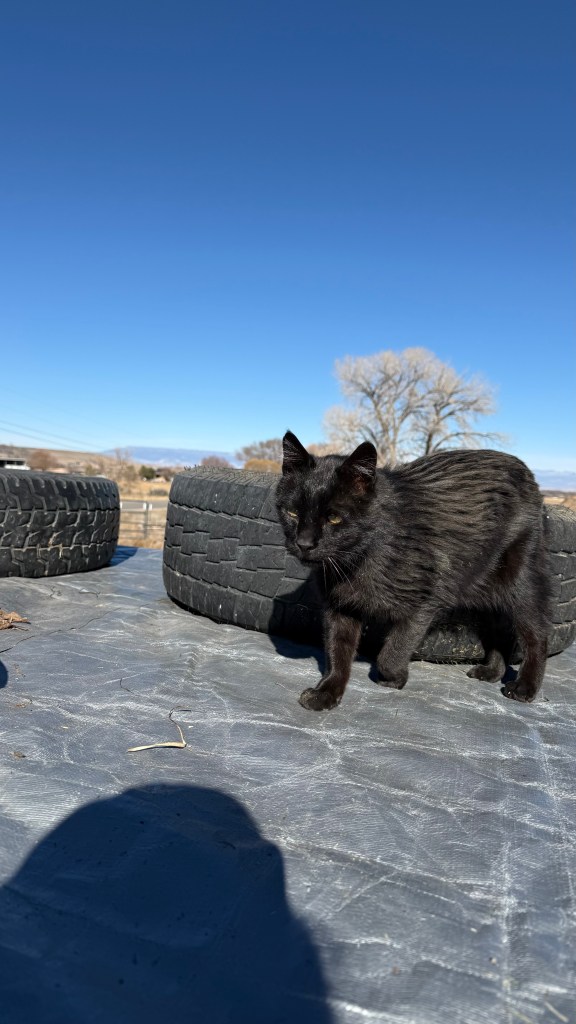
This is when I see my cat Squirm easily climbing the ladder. Once at the top he does a Baryshnikov leap on to the hay. He rubs against me, and then he runs down the ladder as if it is nothing.
“Show off,” I say.
After I get the tarp on, climb down (The first step is the worse, because I never know if I will topple over.), tie it down, and then I load up a bunch of tires on the tractor to place on top of the hay. Time to get back up there.
Once up there, Squirm flies up the ladder as if he has wings. He roams around the top of the hay stack as I look around at the mountains. Sometimes we have to shove our fears aside and take that first step. We have to stop thinking about ourselves solely and think about the whole issue. The needs of all far outweigh my fear. Horses first.
As I look around, I think about the Eagle I see flying around from time to time. He can see the entirety or up close and personal. We tend to look at things to closely when we need to fly like the Eagle.
“Time to get down Squirm,” I say. I start crawling down the ladder. I look up, and there is Squirm one step up above me wondering why I’m so slow.
A friend tagged me in a post about those looks a horse gives us basically when they are saying, “Don’t you dare!” I replied how I thought I was fluent in horse, eye language as a joke.
But, to be honest, those of us that live with horses or dogs or cats or donkeys….alpacas, the eyes speak volumes to us.
Verbal language eventually fades into silence.
I move in silence often with my horses. There is no need to speak. Well, Harley likes it when I say his name.
Every day I work towards having a better, more peaceful relationship with my horses, and so much of it occurs through the eyes.
They look into mine as I gaze into theirs. If I am lucky enough, I will see what their reactions will be through their eyes before their body moves.
I can see their moods before I touch them.
I can see a yes or a no response before they physically act.
I took this picture of his eye ten minutes after I brought him here. I sat on the ground just outside of his area and let him explore and wander without asking a thing of him. He kept coming back to me and dropping his head alongside mine.
His eye told me how tired he was….how injured his soul was….how physically he was on the edge……
Yet…he had a glimmer of hope. He still wanted a relationship and asked me through his eyes if I could give that to him.
This week brought rolling clouds with relentless winds. At times rain or snow stampeded in, and the sun never had a chance.
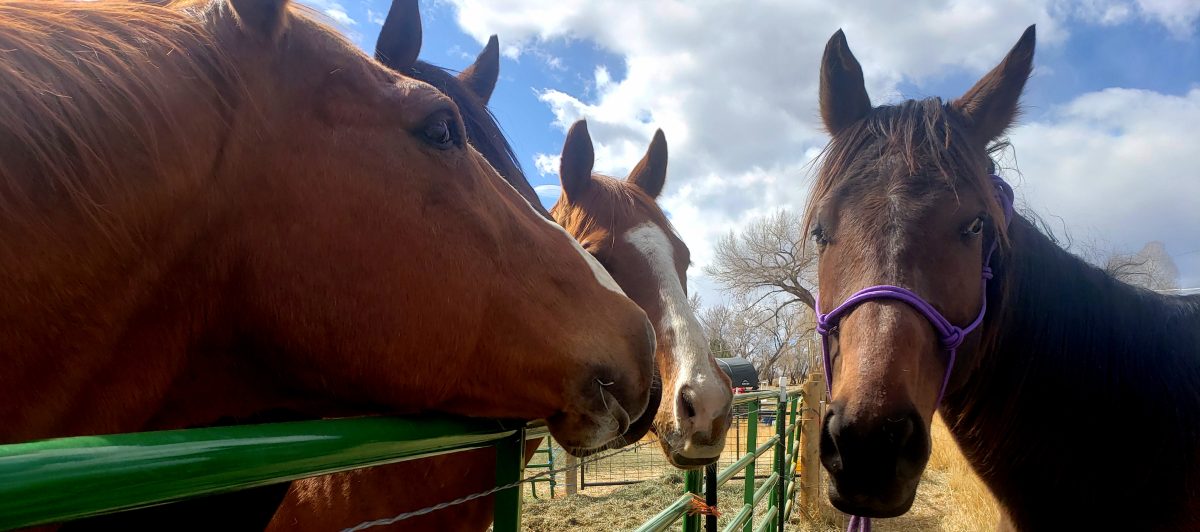
The horses stood in the corner bracing against the winds patiently waiting for that moment; the moments when the clouds would part and a bit of warmth would shine through. They waited and waited for the light. During that time they ate and rolled thoroughly in the mud and went back to standing against the wind.
Yesterday it happened! The clouds retreated, and even though the air temperature remained the same, it felt glorious. The wind stopped. The sun came back to us, and we all stood there reveling in its warmth.
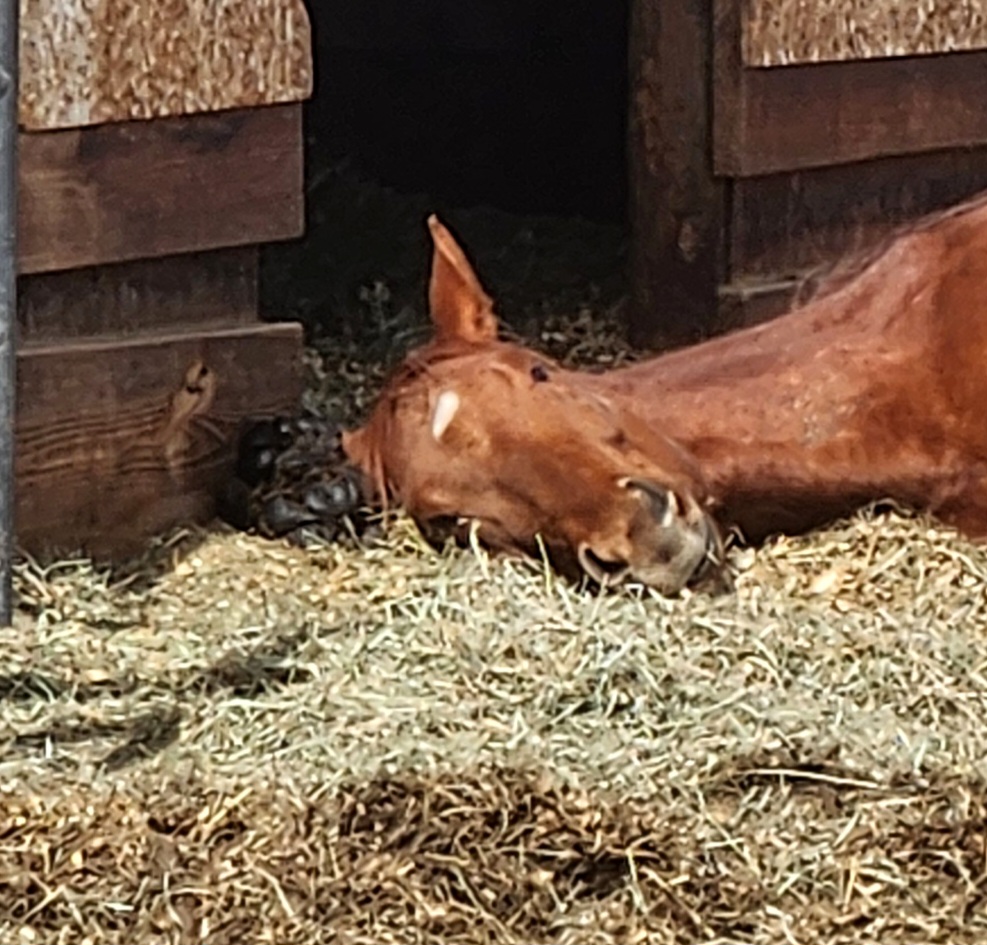
Sueño decided it felt so good that standing wasn’t enough. He needed to lie down and soak it all in. After turning a few times this way or that, he finally bent his knees and plopped down in bliss.
Now, I was out there picking up their poop, and of course he picked the spot next to the last pile of horse poop. It happened to be a deposit from Harley, who never releases anything of a small nature.
I begged Sueño to not stretch out, and to wait for me to get over there to pick that last pile up. Of course he ignored me, and let out a big moan, stretched out and plopped down on his side. Harley’s poop became his pillow.
The alarm sounds and reluctantly my eyes blink open. It is Monday morning. Sueño is pawing the gate impatiently hoping that the sound will hurry me up somehow. Pharoah crawls over to me licking my chin while stretching out every ounce of his being. I put on my clothes and shuffle out the door.
The sky is pitch black with Pleiades hovering above me, and Orion’s Belt is in the upper portions of the eastern sky. A faint hue of yellow barely outlines the mountains as the crescent moon begins its climb. The air is crisp but not chilly. Not even a gentle breeze moves the air. It is as if the whole world is holding its breath.
I remember why. I see the first one. A meteor flies through the midnight blue darkness above me.
I open the gate, and Sueño and Wiz walk on to the pasture with nice long strides. I feel them walk by me as I listen to the sounds of their hooves striking the ground. Harley and Dulce wait for me. For some reason they like me to walk them up to the pasture individually. I first walk Harley. He is my shortest horse, so I easily drape my arm across his back, and we silently walk up to the pasture together. There is no need for a lead rope. We walk side by side in silence.
More meteors dance through the sky. Some brighter than others. Some seem closer than others.
Once Harley is on the pasture, I quietly walk to the barn where Dulce is waiting for me. He pokes his head out for a scratch. After he feels loved on enough, he leaves the barn and we quietly saunter, as only Dulce does, up to the pasture. Again, no lead rope. We walk shoulder to shoulder. I look up and see more meteors making their way through the sky.
We join the others.
They all graze around me as I stand with them in that deep, beautiful, blue darkness. There is something magical about standing with your horses in that kind of darkness with flashes of light sparkling through the sky. Faith, knowing that I was safe standing in the center of these four beautiful beings before the sun colors the sky a different shade of blue.
Weather Wiz’s dam is named Stormy Welcome. That first night together, the rain came. Beautiful rain came to that barren, dried out land. I stood with Wiz in his stall listening to that beautiful rain falling on the metal roof cooling off the stifling, hot air. This was not lost on me.
A year ago, Weather Wiz and I met for the first time in a hot, dusty stall out on the plains. Temperatures were in the upper 90’s without a breeze anywhere in sight. The grass was burnt a light brown in all directions. No water anywhere, but here we were. I wouldn’t want to be anywhere else but there at that moment. This was when we became friends.
It was also the anniversary of when I lost my beloved horse Shandoka. This was not lost on me as we stood there together amidst this horrible drought. I met Shandoka during this long, twenty-year drought. He was a wild thoroughbred at the time. He didn’t trust humans one bit. Before he was given to me, I would climb into his pen, sit on the opposite side of him while looking at the ground. I tried to be as non-threatening as possible. Each day he would come closer to me before walking off. The day he finally allowed me to touch him, it rained. It hadn’t rained in ages, but it rained while we stood there together realizing it could work between us. That is when I decided to name him Shandoka, which means Storm Bringer or Storm Maker. My last night with Shandoka was also during a time of drought, and that night it rained. I knew as those sweet drops fell upon our faces; it would be our last night together.
Weather Wiz’s dam is named Stormy Welcome. That first night together, the rain came. Beautiful rain came to that barren, dried out land. I stood with Wiz in his stall listening to that beautiful rain falling on the metal roof cooling off the stifling, hot air. This was not lost on me.
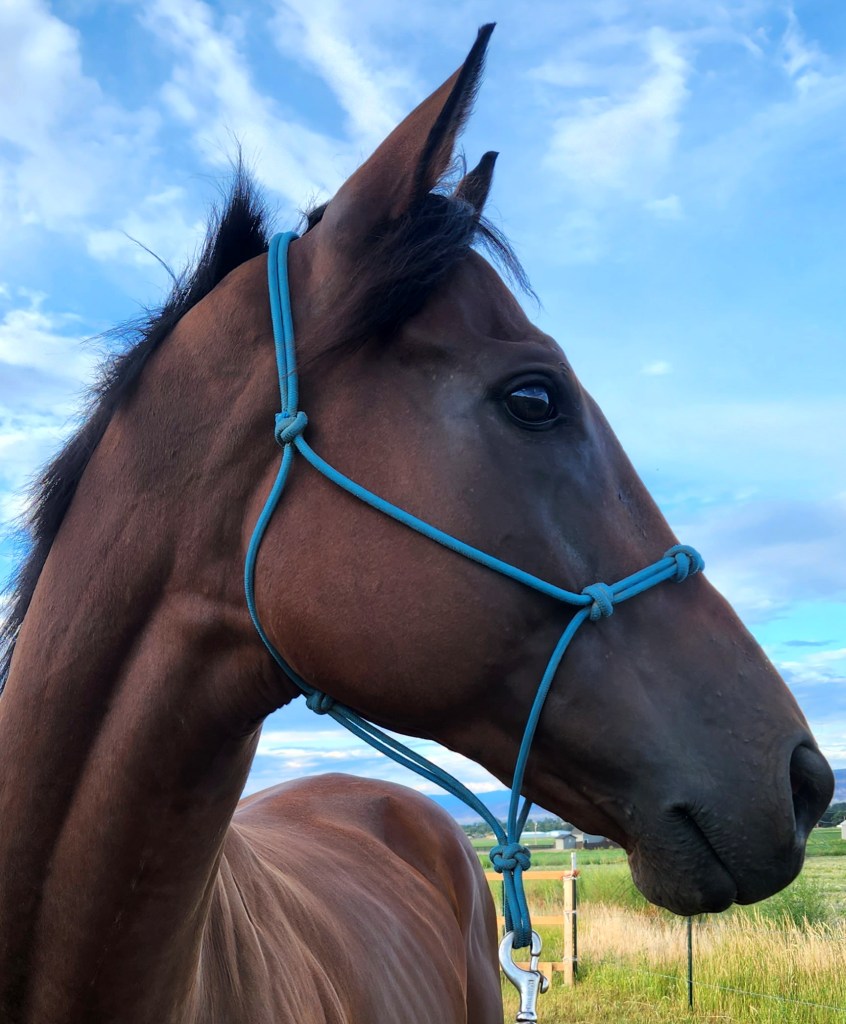
A lot of people ask me what Wiz is like. That isn’t an easy answer, because he is so many things. He is a big horse. I still haven’t sticked him to see how tall he is, but he is taller than me at the withers. When we walk together, I almost have to jog because of his long stride. Half the time he greets me wanting to cuddle, and the other half of the time he is all play. He has the sweetest heart, a big, tender spot deep within, so when I work with him, I always think about that. I want to preserve that, nurture it, and never make him feel like that part of him needs to be hidden. I want to be his safe spot.
He can be nippy, but it is with his lips, not his teeth. When he does that, he is telling me he is nervous; that I need to slow down or break the lesson down into smaller parts. I hand him the lead rope, or I play with his mouth. A chewing horse is a relaxed horse, and while he chews, I figure out a better way to present the lesson to him.
The other reason he can be nippy with those lips, is he is trying to pick pocket me looking for cookies.
Wiz is all about playing. We can be walking together when he suddenly rears up and starts crow hopping wanting to play with me. When the other horses are grazing, he starts trotting circles around them until Sueño or Dulce accepts the challenge, and off they go playing with one another. He may be 9 years old, but that foal in him is still wanting to run around and play.
Wiz likes a kiss on his nose when you bring him a bucket of food before he starts to eat. When it is time to eat, he stands at the fence watching me mix up the food through the back window of our tack room. He can be food aggressive towards Sueño, but that is a two-way street.
When I soak or trim Harley’s hooves, he stands with us keeping Harley calm.
When he is ready to be in his own turnout area, he stands at the gate waiting for me to notice and let him in. He still likes to have his own space at night, but don’t worry, he is surrounded by the other horses throughout the night. Often Sueño is sleeping with him on the other side of the fence. I often open the gate to see if he wants to go out with the guys at night, but he stands there looking at me while eating his hay. Doesn’t move at all. As long as he wants his space, he’s got it.
I’ve been asked if he was retired with an injury. The short answer is no. The long answer is that he was sore all over, and his tendons and ligaments were sore from a long racing career. This is normal for any horse retired from a racing sport. The rest this past year, along with different types massage including myofascial release, has done him a world of good. I also red light acupuncture points. He does not tolerate the needles well, but he loves it when I red light them, falling into a deep, restful place.
I’m often asked if he likes being an OTTB, and my answer is heck yes. He was so ready for this. He loves going up on the pasture in the mornings. He loves being with the other horses, and I think he likes me. I believe he loves not working all the time, and he truly enjoys the companionship and being a horse with the other horses. He and Sueño are like brothers, but he is extremely close to Dulce and Harley. I will write about this in another blog.
The other question I am asked is what will his second career be? Well, the first six months was about letting him learn how to be a horse again. Winter hit and we were buried in snow or drowned in rain. Mud…. we had the longest mud season ever as several atmospheric rivers flowed above us. Trying to work with any of the horses was next to impossible. When the ground did dry out a couple of times, I let him be with the horses instead of asking him to do anything else. I think the prolonged rest, in the long run, this did his body and mind good.
The times I brought out the saddle for Dulce, I noticed something. Wiz got aggravated and would walk at a brisk pace into his stall hiding from sight. The first time I saw it, I took note. The second and third time I saw it, I listened. I needed to figure out a new path for him, something completely opposite of what he’s done in the past. I know I could get on him right now, and he would accept me and do what I asked. However, it would be work to him. I want it to be fun for the both of us.
I had hoped we could go up and work on trail riding, but he is still not the biggest fan of cows. Deer give him pause, and I’m not sure what he would do at the scent of an elk, moose, bear, or mountain lion. This idea is on the back burner for at least another year.
One day I was watching a demonstration done by Jonathan Field, and I knew i found the right path for Wiz. I decided to try Liberty work with him as a jumping off place. It is the perfect choice. It does not resemble racing or his training in any shape or form. We need to do groundwork, but I want to make it fun for him. He loves to play, and he already follows me around as it is. Liberty is all about playing and dancing with your horse free of all tools such as a lead rope, halter, or saddle. We’ve begun on the basics, and he is picking it up nicely. He seems to like it, because he waits at the gate for his turn. Who wouldn’t want to dance with their horse? Horses seem to like to dance with us too!
Shandoka and I used to play hide and go seek. I would hide from him, and when he found me, we would run all over the place together.
None of this is lost on me. So many full circles.
We are so happy Weather Wiz is here. He is a blessing in every way, and he makes us all laugh each day. I love it when he wants a hugs or wants to goof off. He is a character in every way, and he fits in perfectly with our small herd. Happy 1st anniversary Wiz, and your are so missed Shandoka…..but I know you had a hoof in bringing all of these horses together.
If you don’t know what Liberty work is, here is a video. I will post updates as we progress.
Weather Wiz that night a month after he came to live with us.
The wind pounded us, assaulted us, and wore our minds out yesterday. It was unrelentless as a cold front pushed up against a warm front and they battled it out. I stood with the horses thinking about a warm, summer night walk with Weather Wiz.
When Weather Wiz arrived here, he of course wore shoes. If you know me, you know I am all about transitioning a thoroughbred to being barefoot, and I couldn’t wait to begin with Wiz.
One of the things I immediately noticed when I met Wiz was that he tripped a lot, because his hooves were landing toe first instead of heel first. He walked as if he wanted to go on pointe like a ballerina. Some people think this is the proper way for a horse to walk, but it is anything but. It causes a lot of destruction to the hoof. It tears the hoof wall away from the underlying structures weakening it, which can lead to issues such as laminitis. What causes a horse to do this? Usually it is because they are heel sore from an issue such as thrush, or worse, they can be navicular, etc. Also, wearing shoes constantly can cause this heel soreness to occur, and couple that with a horse that runs at incredibly fast speeds, and that pain only worsens. Imagine how you would walk if both of your heels were bruised? Probably toe first, and now imagine how much pain you foot and legs would be in from walking toe first all the time. This is what happens to horses.
When I looked at his heel bulbs, I saw that they were severely contracted with his heel bulbs butting up against one another and upwards. He definitely was heel sore. My first priority was to pull Wiz’s shoes.
He was such a good horse about letting me pull his shoes. I am not a big fan of pulling shoes with clips on them. It makes it a bit more challenging, but after pulling out a couple of nails, I was able to easily pull them off. He barely knew me, yet he stood perfectly still. After they were removed, I saw that his toes were bruised from the repeated toe landings. His heels were uneven, so I began to gently file on one of them when he pulled back violently on me terrified by the pain that I unknowingly inflicted upon him.
After I calmed him down and reassured him, I saw how the heel horns were blood red just underneath the surface. They were badly bruised. I could only use the fine side of the rasp gently to get his heels to the right height. I whispered to him, “I bet it hurt to run didn’t it buddy?”
The best thing for rehabilitation of sore heels and to encourage a heel-toe landing is to walk the horse. For the first two weeks he wore Cloud boots. After that he was fine to go barefoot. Each day Wiz and I went for walks four to five times a day all around our property. Not only was it great for his hooves and their healing, but it helped Wiz and I get to know one another.
I know Wiz enjoyed our walks, because he waits at the gate for me when it is time to go out. During the summer, we meandered all around as I learned what made him nervous, what sparked his curiosity, and how I never felt like he wanted to break free from me. I’ve never put a chain across his nose, or any of my horses for that matter, and I can walk him with a light feel on the lead rope. He is a joy to walk with.
We often stood together gazing in the distance at other horses, or he would play with me and the lead rope. Wiz loves to play, and he shows me that for training in the future, to always include some aspect of play into it. He also loves to hug. When he needs contact, he will gently rub his head all over you. He never pushes you, he is always gentle about it, and it is loving.
One thing I noticed the first month he was here was that he didn’t want to canter, didn’t want to trot, and galloping wasn’t even a thought in his mind. He always remained at the walk, because those heels were so sore.
When you first pull shoes off a horse, the hoof expands, because nothing is holding it into some predetermined shape anymore. Thus, I trim every two weeks to make sure that nothing becomes a fulcrum that can cause cracks or any further tearing of the hoof wall from the underlying structures. Each time I worked on him, those heels were red until we hit the month mark when two of the heels on his left front were normal. He didn’t even twitch when I rasped them.
Our last walk of the day during those warm, summer nights was always around 8pm. We would walk up to the top of the pasture, and listen to the water flow along the irrigation ditch before we headed back to his barn. I usually would unclip the lead rope and we would walk together at liberty.
One night I removed the lead rope like usual, but he didn’t follow me. Instead he watched me. I kept looking back to see if he moved. He didn’t. When I got within twenty feet of the gate, he gave me a look, arched his neck, and he opened up. He didn’t trot or canter, but he ran as if he busted out of the gate on some track in his memory. He ran straight for me. His hooves seemed to barely hit the ground, yet they made the sound of thunder. As he dropped lower, the wind tried to keep up with him as he flew through the air. My breath escaped me as I watched the racehorse within him return. He blew past me only to corner on a dime that a horse as a big as he is shouldn’t be able to do. He then trotted to me with his head held high, nostrils flaring, and tail raised. He touched his nose to mine.
“Wow! You are amazing Wiz,” I whispered as I stroked his neck.
I clicked the lead rope back on, and we walked back to the barn together both of us smiling.
One morning after feeding the horses I came in groggy plopping down on the couch for a few minutes before I began the rest of my day. I mindlessly surfed through Facebook to see if there was anything that needed to be seen when my thumb stopped on a post.
A woman was looking to rehome her thoroughbred that had a life changing issue forcing him to be retired. Immediately everyone told her to put the horse down even though he had many good years ahead of him. His main issue was that he no longer could carry weight on his back. Half of the people said to put the horse down to prevent kill buyers from getting their hands on him, and the other half said to put him down because he no longer was viable for any form of competition.
Well, I have something to say about this.
I believe if a horse isn’t in pain, wants to live, shows joy each day, then you fight for that horse. Racehorses, and all other horses, give so much to us. They don’t ask to run around big ovals or small circles around barrels. We train them for it. and they take part due to their relationship with us. When it comes time for them to be retired, they need us to stand by them and do what is right.
I’m tired of people thinking that a second career has to be some form of competition. There are all kinds of second careers for horses. A horse can be a therapy horse. I helped rehome a thoroughbred with a young girl that suffers from bad anxiety. The horse suffered a double bowed tendon from racing, and he wasn’t supposed to do much of anything anymore. These two coming together changed both of their lives. That is a Second Career.
My friend Sherrie Courtney of the very good Thoroughbred rescue Racing for Home, recently took in a horse named Brooke’s All Mine from Gulfstream Park. After arriving at her place, Brooke became terribly lame, and some thought she might have to be put down. However, Brooke still had that spark of life shimmering in her eyes, and Sherrie saw that. She did everything she could for her after finding out she had several chips and a hole in the cartilage. Brooke ended up having to get arthrodesis surgery. This is a rare surgery, which fuses joints, so several surgeons came to observe it. Because of Brooke, they learned how to do it, and who knows how many other horses Brooke will save. That’s a Second Career.
(Brooke is now walking around quite well, and she recently returned home. If you wish to donate to her rehab needs, please visit Racing For Home’s page at https://racingforhomeinc.com/)
My horse Quarter Horse Harley came to live with us to be a companion for my horse Shandoka. He was a great companion for him, and Shandoka absolutely adored him. I think people underestimate the importance of this role with horses, and it is a perfect job for a horse that suffered a career ending injury or getting old. A companion helps prevent ulcers by reducing stress in the other horses. Horses are herd animals, and they need to have their friends. Being a companion horse is such an important job. That is a Second Career.
Harley is now a companion and teacher to Chaco, Dulce, and Sueño. Harley taught Chaco and Dulce about trail riding and keeps them calm. He will also teach Sueño when it’s his turn. When I trailer Dulce for rides, which can make him very nervous, Harley always comes. Harley keeps him calm in the trailer. That is a Second Career.
Let’s not forget about Peanuts who escorted and kept the great racehorse Exterminator calm on his way to the starting line. Exterminator out lived a couple of Peanuts, but he always had the spirit of this pony by his side. If you compete, your horse that needs to be retired, or a horse looking for a home that can’t be ridden, can go with your horse to competitions to keep them calm and focused. That is a Second Career.
When Chaco became severely lame, and even after he had great improvement after his first Noltrex injection, an a person I did not know wrote telling me that I should put him down….that having a “pasture rat” isn’t worth it. He needed to earn his keep. I must say this was a punch in the gut. Chaco has so much life, loves to play, and always tries to find ways to outsmart me on our walks to snatch grass. He ran for a year after going down in a race with three pebbles lodged in his stifle destroying his cartilage. As far as I’m concerned, he deserves all of the time I can give him, because he gave so much to humans. As long as he wants to live, I will fight for him. He is teaching me so much. That is a Second Career.
When the neighbor’s grandchildren come to visit, they always come down to see my horses when they are on pasture. Chaco, my tallest horse, gently drops his head for them and lets them love all over them. Their mother told them that her kids have never been around horses before. When she asked me what kind of horse he was, she couldn’t believe that a thoroughbred could be so gentle and calm. Chaco is educating young kids and older adults about how amazing thoroughbreds are. He is an ambassador even though he can’t be ridden anymore. That is a Second Career.
Horses make great therapy horses. A neighbor down the road works with unwanted drafts and children with physical disabilities. Horses amaze me in how they can heal broken spirits and minds regarding vets or others who struggle with PTSD. Let’s not forget that incredible video of the OTTB in France that walks the halls of hospitals visiting with patients he decides need him the most. https://youtu.be/XypgQoOBuBk
Horses don’t have to jump, do piaffe’s, or wind their way around barrels to be worth their weight in gold. There are so many second careers that a horse can have, so before you toss a horse away due to an non-life threatening injury, consider what else your horse may be able to do. Talk with your vet about the possibilities. Talk with people in different fields with horses such as therapy horses to see where your horse can fit.
There are all sorts of Second Careers that require no competing or challenging riding.
If you have to rehome your horse for whatever reason, you do need to worry about your horse falling into the wrong hands. There are stories all the time. Here are a few suggestions:
Don’t give your horse away for free. This brings the bad guys out. If a kill buyer can get a horse for free, they will.
Write up a contract specific to your horse regarding care, visits by you, update pictures, and how if they decide they don’t want your horse anymore, they contact you first. This will usually chase the bad guys away.
Get four references. Make sure they can afford your horse. Find out who supplies them with hay. Ask to talk with their vet.
Talk with other rescue organizations for tips on how to place your horse successfully.
Sherrie Courtney added, “I’ve found that adopting to someone with whom there is some kind of a connection (vet client, trainer’s friend of a friend etc) has worked best for me. So I always know things are ok. I ask for updates (photos) a few times a year so as not to be a pest. Contract can state all of this as mine does.”
When I was struggling with severe exhaustion caused by Covid, I had to lean up against the fence panels to get my breath. I needed to get my horses fed, and my body was fighting me every step, every breath. I tried to not cry, not panic, and breath.
I couldn’t catch my breath.
Chaco walked up to me, put his nose on my cheek, and I felt his breath. His breathing calmed me down, and my breath began to slow down matching his. We stood there breathing together until I got my strength back. He pulled back and looked into my eyes before sauntering off to play with Sueño. His Second Career is all about taking care of all of us, and he is so good at it.
My grandpa was probably the kindest person I’ve ever known. Our horses loved him, and when he went in with them, they all ran up to him. I remember the first time he taught me to shake hands with a horse. I have no idea how old I was, and to see it, I need to close my eyes. It is more a sensory image, because I was so small. I know that my mom was standing behind me. My grandpa urged me to hold the back of my hand up to the horse while tucking in my thumb. He always said that you don’t want the horse mistaking your thumb for a carrot. I’m not even sure which horse it was…I think one of the mares. Maybe it was Chiller, our racing quarter horse at the time. I can feel the soft nose on my hand, that warm breath, and a smile that emerged not just on my face but my entire being when the horse accepted me. I then looked up at my grandpa, and there was that smile of his that I lived for.
He had a way with horses that I’ve never come close to. I loved it when my mom dropped my brother and I off at his home, because he almost always took us to see the horses. When we were there, except for the time spent following Charlie the turkey around, I watched him. I watched how he caught the horses, brushed them, checked out their legs, loved on them, played with them, and how he simply stood with them. I think a lot of us forget to do that; just stand with our horses. We’re always doing something….picking their hooves, brushing them, training them, taking them for rides, but we rarely hang out with them. He did and the horses would walk up to him and then walk off. He never chased them.
One day I wanted to pet my horse Big Ruckus. I followed him everywhere, and I never could get a hand on him. The faster I walked the faster Ruckus walked to get away from me. Frustrated and broken hearted feeling like my horse hated me I went up to my grandpa feeling like an utter failure. When he asked me why, I explained how Ruckus would never let me pet him. He told me, “Stop trying.”
He didn’t mean give up and walk away. Rather, in order to find that connection with Ruckus, I needed to let go of my need for it and chase Ruckus around with it. Horses don’t always agree or understand our goals that we impose upon them, so they run away from them. Sometimes the best way to get anywhere is to surrender it and simply be with your horse. My five year old mind wasn’t too sure about what he meant, but I decided to copy my grandpa. I went back down to their pasture, and I stood there doing nothing. Within a few minutes Ruckus came trotting up to me, and I got to pet him. He then grabbed my shirt, and he started dragging me all around as we played.
I’ve spent hours asking myself what was it about me that caused that to happen that day. We were riding around so relaxed, and when we went to a trot, it all changed. He had been a bit nervous in the arena, and this is why I spent a lot of time introducing him to it. When he seemed settled, I asked him to trot. Was he settled? I don’t think so. I think he was anxious horse, but he knew how to bury it like all horses do. However, that day something gave, and he showed me what he had been burying. My failure to acknowledge that the muscles underneath me were saying, “I don’t like this place or this situation,” pushed Dulce to that watershed moment where I could finally do the bodywork he needed, which is a good thing, but…..it isn’t good that I misread him.
Now that it seems time to ride him, I’m hesitant. I finally got him to such a great place, and even though I have the tools to keep him in a good place, I worry about ruining it all, missing out on what his body is telling me.
I can hear my grandpa whispering in my ear saying, “Stop trying.”
I think I was trying too hard with Dulce. I wanted to show everyone what a great OTTB he is by what he could do instead of paying attention to the fact that his mind needed extra help. Work for him meant anxiety, and I want work for him to mean fun. So, I need to stop trying.
I keep thinking about Shandoka, and how we always played together during training. I don’t want to trigger Dulce again, so the other phrase my grandpa said a lot about horses that is being whispered into my mind is, “Get creative.” The word “deconstruction” keeps going through my mind. I need to deconstruct. I need to deconstruct the way he looks at what work is, and recreate a new and better way for us to enjoy our time together.
Some may say he is a hot horse, but that really isn’t it. He gets anxious the moment he sees a saddle, he paws and shakes the trailer when loaded, and that day in the outdoor arena, he went into a posture I never asked for, and began grinding his teeth. Work stresses him out, because it caused him pain. I need to deconstruct everything with him in order to rebuild. I want to show him that our work together won’t cause him any discomfort, and if it does, I will stop. I’m listening to him. Currently, I’m breaking everything down into small blocks, and going over them slowly with him. If I notice any anxiety, I immediately do the Masterson Touch on his TMJ area until he relaxes, and then I break up what we are doing into smaller blocks.
This means that I need to deconstruct my views on training, and explore new and different ways of working with a horse. I never thought my training methods were harsh or wrong, but I do think that there are other more creative ways. I’ve been looking at Mark Rashid, Tik Maynard, Alexander Nevzorov, Carolyn Resnick, Manolo Mendez, Ray Hunt, and others.
I have the chance to create something so different for Dulce and Sueño, and to do that, I need to change me as well. No more goals the way I’ve used them. Throwing out expectations is required, and time to work in a way that allows their bodies to stay in balance. I have no idea what this will end up looking like, but I’ve begun to experiment.
For the past three days I’ve gone out and done what I would call interactive groundwork. What is that? I have no idea how to tell you. All I can say is that I am as involved in the groundwork as they are. We move around together. I keep my eyes on theirs. We yield hindquarters and forelegs, but it is all through a dance that I do with them. Twice I’ve done it without a lead rope and once with. I’ve never done Liberty work before, but it amazed me at how quick Dulce and Sueño picked up on what I was asking them to do. Most of the time we work at the walk, but every now and then we go up to the trot. The thing I like about it so far is that Dulce and Sueño seem to be having fun. They let out these great sighs, their heads and ears are up and on me as we dance with one another. Will this help in the saddle? I have no idea. Time will tell. All I know is that I stopped trying, and that part of me that died with Shandoka came back….that creative side that loves to play with horses….that five year old standing in the pasture imitating my grandpa as Ruckus walked up to me is coming back to life and my horses seem to love it.
Ever since I brought Dulce home, I found pain in his body. His poll was locked like all racehorses, but his seemed to be locked up in a super max prison. He guarded his entire body, and would pin his ears wherever I touched him until he realized I wasn’t going to do anything but pet him. Petting him with the back of my hand eased his anxiety. His entire body was on guard against any outside force no matter how light the touch was.
The areas where I found the most pain in the beginning were the poll, TMJ, shoulders, and psoas area. I also spotted three straight white lines on his withers.
I tried Tellington Touch first, and he hated it. He stomped his hooves, his tail swished, and those ears became glued to his head. I switched to the Masterson Method, and he responded immediately. I used the lightest touch, or what Masterson calls “ethereal” touch. I barely skimmed the hairs with my fingers. I searched and searched for blinks, which indicate a source of pain, and stayed there with that ethereal touch until he released. A release is expressed through yawns, movement of the jaw back and forth, sighs, head shakes, and my guys like to rub their heads on me. At the end of this blog, I will post links for you regarding any of the massage methods mentioned here.
The thing is if I ever tried to take anything a bit deeper with him, he’d go back into protective mode. His body would tighten up, and we were back to ground zero. He constantly teaches me that my goals are not his.
So, when we had that moment in the arena, it was a watershed moment for us. Somehow, the door opened wide, and he couldn’t slam it shut. He let me in completely; not half way.
He released more and more with the Masterson Method, but I could tell that his ribs were stuck. Yes, I took him to a chiropractor, but it didn’t last. His muscles brought him back to ground zero again. I needed to create the change on a muscular level for his bones to stay in a healthy place, and that rib cage of his was screaming out to me for help.
I began researching and watching video after video. I ordered a book on Osteopathy. We have no osteopaths on the Western Slope, and I feel that osteopathy addresses the muscles and resets the bones. I didn’t feel comfortable doing any of the thrusts, but several of the other moves were easy for me to do. The most important thing is that Dulce responded.
Layer after layer came off. His body was healing, and he was able to bend better as we did his active stretches out of Helle Katrine Kleven’s book Physical Therapy for Horses. I love doing these stretches every day, because they tell me where my horses are at. What can they do or not do? As we progressed, he became more and more supple.
The pictures below are a few of the active stretches she suggests.
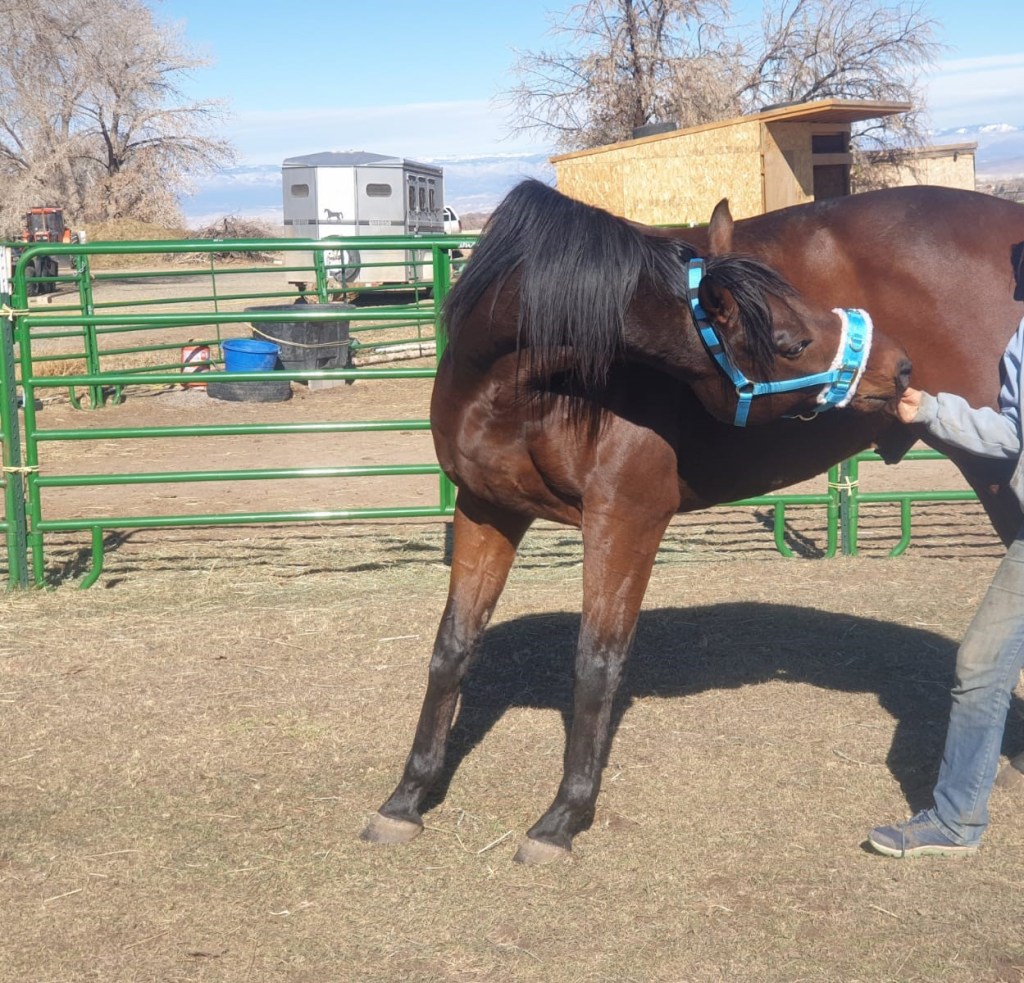
Dulce used to struggle with doing this one. He could reach his head straight ahead with a twist, but not straight ahead and up. After all of this work, he now does it easily.This one used to be difficult for him to do while keeping his head straight. He used to turn his head to the side. Now he can easily reach to the side with his head held straight.He never could bow before I successfully reset the muscles and his C1 and C2.
The ribs, the ribs, and the ribs. He was so tight in the ribs, and this is when I found April Love who had a very simple method to release the ribs. I fully expected him to bite me, but luckily I got through it before he could. With this one maneuver, I could tell he felt better. He could lift his stomach! He never could lift his stomach before. Often horses for many reasons, saddles and us being on their backs, get their ribs stuck on the inhale position. He had a few stuck there. Love also talks a lot about the first ribs being out. I did the test to see if they were, and lo and behold, on both sides his first ribs were out. I enrolled in her class, and before you know it, I was able to reset his poll, first ribs, ribs and hips.
Before I reset his ribs, he could only go back to mid barrel. Now he can reach all the way to his stifle easily. This stretch is not only great for the neck, but also the outside shoulder and all of the ribs.
Did I stop using the Masterson Method on him? Absolutely not. I used it in conjunction with all that I was learning. The Masterson Method brings him to such a deep state of relaxation now that I am able to use that first before moving to a maneuver that brings about a deeper shift.
I then enrolled in a class on myofascial release. I feel that to keep his muscles relaxed, I needed to keep the fascia supple, and his was not especially around the pectorals, sternum and rib cage. If I even approached his pectorals or his sternum, his guard went up, and he let me know to back away. I went back to the ethereal touch of the Masterson Method for a couple of weeks on these areas before he finally allowed me to do some myofascial release on these areas. I still have a ways to go, but we are making a lot of progress.
His TMJ though was a continuing problem. I could get it to release and the next day or hours later it was tight again. No matter what I did, an I found a wonderful maneuver from the late Dr. Kerry Ridgway, that TMJ was always in pain throwing off his entire body.
Finally, I got an appointment with his dentist. Covid and the Holidays made it challenging. He wasn’t due for another six months, but I knew I needed to get him in. Last year I took him to someone else, which was an absolute mistake. I had a good intention, but that intention blew up in my face in so many ways. I learned the hard way to stay with what you know, and I know my equine dentist is fantastic.
I expected him to tell me that Dulce couldn’t be helped. Instead he showed me how his front incisors had a slight diagonal to them from right to left. He told me that horses with this slight diagonal have severe TMJ pain, but horses who have severely diagonal teeth don’t. He was able to fix his. He told me in a month, his TMJ pain would be completely gone. I can’t even begin to tell you how happy I am that I found a reason behind all of this.
He also suggested something I already do. I feed all of my horses on the ground. This stretches out the TMJ and the poll muscles as they chew keeping these areas supple. He said feeding on the ground helps the teeth stay as well, because it allows the jaw to move from side to side. When you feed at a higher level like a hanging hay net for instance, their teeth get locked. Instead of moving from side to side they only move from left to right or right to left instead of back and forth. At least I’m doing one thing right!
Dulce was always a lovey horse. He’d follow me everywhere after I brought him here, and he was always the first to greet me in the pasture. However, he also had a very grumpy side that Chaco was often the recipient of. This whole journey to bring his body back into balance opened another door for our relationship. He is sweet, happy, playful, and relaxed. He is back to coming up to me each time I enter into the paddock or the pasture. He wants to cuddle and is more willing to move forward with me..and he wants to play.
I haven’t ridden him yet even though I can. I’m hesitant. Even though I have the tools to keep him in a good place, I worry about ruining it all. Mainly, I keep thinking about Shandoka. He and I used to dance with one another, play with one another. We’d play hide and go seek, chase….. When he died, that part of me got buried with him. As I stand and look at my horses, I realize how much they need me to resurrect this.
For us to move forward, and by us I mean Dulce, Chaco, Harley, playful Sueño, and myself I need to deconstruct and rebuild……
If you are interested in learning equine massage techniques, there is a wealth of information on YouTube. First, in no way am I recommending that you do any of this with your own horse. Please consult with your veterinarian before embarking on any of this with your horse, and I am in no way responsible for anything that may occur to you or your horse while working on your horse. Horse massage can be very dangerous to you and the horse. When I discovered a sore spot, I’ve nearly been cow kickek out at; all of which are ways the horse is trying to tell you that he or she is in pain. I never punish a horse for trying to communicate with me. Proceed at your own risk.
When I was a kid, my dad would take us up to my school’s baseball field, so he could practice throwing his curve ball. I stood in the batter’s box nervously waiting for him to pitch that curve ball from hell. I took every last nerve and ounce of courage for me to stay in that box while praying to every possible deity that the ball would curve and not hit me in the head or ribs. No offense to my dad, but he was no Clayton Kershaw. Sometimes I jumped out of the batter’s box and other times I stayed put facing that ball down until I either landed my bat on it or it whizzed by. (My dad’s curveball always did curve thank goodness!). This is what it’s like having horses at times…hoping that curve straightens out and goes over the plate rather than hits you head on.
At the beginning of summer, things began to go wrong with Dulce. Part of it was the death of Mojo. As I wrote in an earlier blog, he took it hard. Whenever we went on the trail he was fine, but if we went to the arena, which he used to love to do, he suddenly was miserable.
I am 100% sure he was trained in side reins. They are used quite a bit in horse racing and all horse disciplines due to the belief that it helps the horse get off the forehand and move their driving force to their hind end and gets the horse on the vertical. I listen to Simon Callahan on TVG praise their use quite a bit (for the record, I really like Callahan just disagree with him on this), and if you are in my presence, you hear me have a few words with him through the TV.
Imagine you are in a yoga class, and the instructor asks you to bend forward and touch your toes. Now imagine that the instructor puts his or her hand on your back after you get your hands down to your toes and says,”Okay, I’m going to keep you in this position for the next fifteen to thirty minutes, and I’m going to make you walk around like this.”
Horrified, you start to move around unable to get out of this position, and you notice that you are bringing your chin into your chest. The instructor praises you for your collection when in reality you are trying to figure out a way to escape the pain. At first you can walk on your legs, but your hamstrings and glutes begin to burn bad all the way down to your feet from the constant pull on all of the muscles and ligaments/tendons. What do you do to try and escape this? You lean on your hands trying to walk on them to give your legs a break.
This is basically the same thing that happens to a horse when they are in side/draw reins. Instead of trying to figure out why a horse won’t collect, they go to an easy solution; force them with the side reins. So what happens to the horse? First they move into an incorrect frame bending in a horribly painful way at the pole and in the neck to get behind the vertical to try and find some relief. You never want a horse behind the vertical. The nuchal and supraspinal ligament are constantly being pulled on. While this does cause the back to lift, the sacrum is incorrectly and painfully being pulled too far forward. The pelvis will tip and go flat causing a strong pull on the flexor muscles of the hindquarters. Thus, the hindquarters are pulled towards the back. This causes tension to build up in the ischium muscle, longissimus muscle of the back, and the gluteus medius.. The loin and the abdominal muscles are no longer able to raise the pelvis, thus the hindlegs can not step under. What this all means is that a correct and healthy collection for the horse is impossible to attain.
They then move on to their forehand putting a lot of stress on their chest and shoulder muscles causing the front legs to lose their ability to absorb shock. Why is that important? The muscles of the forelegs then lose their ability to bring the legs forward in a healthy way, and their tendons and ligaments can become injured or strained from the the inability to absorb the shock.
The world renowned equine physical therapist Helle Katrine Kleven writes in her book Physical Therapy for Horses:
“The cervical spine becomes kinked in a way that is physiologically unnatural, which causes tension and blockages in the small, deep muscles. This can cause irritation where the nerves leave the spinal column, as the incorrect positioning of the spine causes the spinal canal to become too narrow. Over time, this can lead to instability of the spine and/or calcifications on the ligaments as these are constantly overstretched. In addition, inflammation that eventually becomes calcification on the nuchal ligament can result.
“When the horse is ridden….nose behind the vertical, the rider is automatically locking the first cervical vertebra opposite the head. Therefore, a sideways longitudinal bend is no longer possible. The horse makes a compensatory movement, in that he turns his whole head between the 1st and 2nd cervical vertebrae when asked to turn.”
She goes on to say that the more the rider pulls and keeps the horse’s neck in hyperflexion, more of the vertebrae become locked, and the mobility of the horse’s spine is diminished.
Can you imagine how painful this is for a horse? There are some auxiliary reins like Vienna and Lauffer reins that can be helpful. I prefer in training to use none of these. I believe in working with the horse’s natural confirmation whatever that might be. That is just me.
Dulce and I were having great rides together on the trail and in the arena until one day I took him to the outdoor arena at the fairgrounds. That is the day that everything changed, and the curve ball hit me.
When I asked him to canter on a loose rein, he suddenly went into the stance of a horse in side reins. He nearly pulled me off of him and over his head his nose was so far down and behind the vertical along with being heavily on the forehand. I stopped him. Pet him. Talked to him. Walked him and when he was relaxed, asked again. He did it again. I thought I would try to ride him through it, but it got worse. He suddenly started to canter with his head sideways. We came to a stop. I got off, checked his bitless bridle. Everything was in the correct position. I hand walked him, longed him, and everything looked fine. I decided to try one more time.
We walked calmly, I gave his verbal cue, and again he went into a side rein stance, then the head went sideways, and he bucked. I got him to stop, hopped off, and this began a six month journey of healing for Dulce that I will begin to cover in the next two blogs, although he and I are still on it as we move back into training. It involves a lot of bodywork that I studied and took classes in and dentistry work all because of side reins that I am 100% sure he was trained in. Something happened that day that triggered him, and for the life of me I don’t know what.





 Reenchanted Thoroughbreds