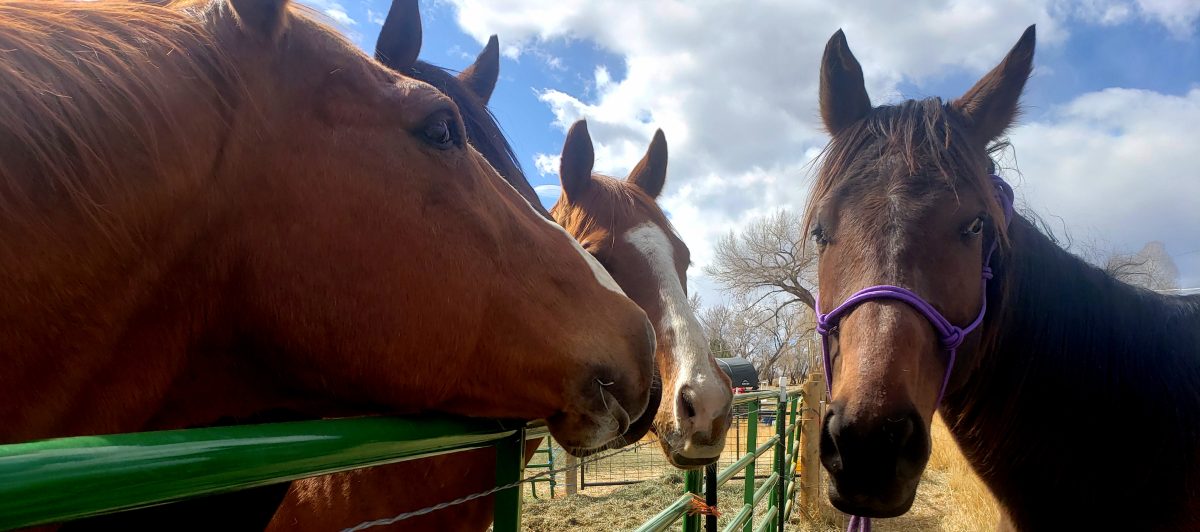
Good New About Wiz!

And somethings to think about

If you’re reading this, you know that Weather Wiz has been having soundness issues. My vet came out here and did x-rays and diagnosed him with sesamoiditis. He sent the x-rays off to Dr. Lamb at Roaring Fork Equine Hospital for possible treatments plans. She suggested a thorough ultrasound and PRP Therapy.

We have been inundated with monsoons for about three weeks, which is highly unusual. They usually don’t start until mid-July. The rivers are high, and we were in a flash flood watch when I loaded Wiz into the trailer to head through the West Elk Mountains to Glenwood Springs.

Wiz runs warm, so I chose to go through the mountains to keep him cool. It got a little dicey on the way. There were several spots where the material from the pull off spots had washed across the road, and water from new streams meandered along the roads to the other side into the river below. I came across two mudslides that were luckily being cleaned up as I got to them, and there were some mini rockslides. It lightly rained the entire trip, and it was an amazing drive despite my stress. Wiz and I literally got to drive through the clouds as we descended McClure Pass.

Once we got to the hospital, we waited for maybe five minutes before it was our turn. I unloaded him, and he handled everything like a champ. I am so proud of my rambunctious guy.

Some people think that this may have happened due to his training with me, and to be honest, I was concerned that I did something. For the life of me, I couldn’t figure it out. I’ve always had some concerns about his right leg, so we have worked really slow. I haven’t even lunged him, which turns out to be a very good thing.

What has been happening? Well, the first time, he got up from a nap, did a little yoga, and suddenly he was three-legged lame. I kept him in a small area, and he did worse. I decided to take him out to hand graze, and guess what? He was 90% better in three days. After six months, I started letting him do more. He was doing great. One morning I was watching him on the cameras, and when he got up from his nap, he was three-legged lame again. I went back over the footage, and he was sound before he plopped down for his nap. Again, I put him in a small area, and he didn’t improve at all. He was scared to walk. I took him out for a hand graze, and he improved 50% due to that short walk while eating. In three days, he was almost 100%. The main tell right now is that he can’t cross his right leg in front of his left if he does a tight turn.

According to Dr, Shull and Dr. Lamb, the sesamoiditis is from his horse racing days. He has definite changes to his sesamoids, changes that make me cringe, and one very bumpy area that we need to keep an eye on. We have our baseline x-rays and ultrasounds of his sesamoids, so we can note any changes from year to year. Dr. Lamb does not believe his lameness issues currently have anything to do with his sesamoiditis. Sesamoiditis develops from repetitive, concussive work such as jumping, barrel racing, and horse racing.

This is good news that it didn’t flare up.

She then began examining his tendons and ligaments their entire length and origins and insertions. She said, “The good news is there is nothing major going on here, and nothing to stick a needle into (referring to the PRP therapy we thought he needed).”

What she did find were two old injuries to his suspensory. One is at the medial distal branch, and the other was halfway up his cannon bone. I hoped to have the image, but I haven’t received the report yet. The fibers of the healthy part of the suspensory are long, and then you see much shorter fibers. These two areas are what she thinks are bothering him. He reacted more to the area halfway up his cannon bone.

These are old injuries from his horse racing days. What she thinks, and what I saw, is that he tweaks them doing yoga or getting up. Imagine getting up out of bed or off the floor. You might get up in a weird way or slip a little bit, and then you tweak that muscle in your back or your knee. This is what Wiz is doing. This is why movement improves it instead of makes it worse.

She said that the ligament has great tone, so our hand grazing and ten-minute walks in the mornings are benefiting him; not hurting him. She and Dr. Shull both told me that I had it figured out and to keep doing it. I can never lunge him. Not only is it bad for his suspensory but bad for the sesamoids. Whenever he works, he will have his Cavallo boots on, and his suspensory, orthopedic leg wraps. She showed me where to use the red light on him, and she told me to keep doing the myofascial release work I’ve been doing on his leg and for his body. His tight shoulders and poll that I am releasing every couple of weeks are definitely tied to this. For the record, I have not given him any pain meds; only herbal anti-inflammatories and icing or cold hosing.

The great news is he doesn’t need any pain meds! Instead, I brought home a tube of Surpass for whenever he has a flare up, and that probably will happen for the rest of his life. If he doesn’t recover in a short time, we will head back up to Roaring Fork for another ultrasound to see what changes have happened and treat as needed. He may need PRP one day, but right now, it is all manageable.

We can return to Liberty work, because his leg needs it. It will help keep his leg healthy as long as I don’t let either of us over do it. It is all about balance and will be low level work. We will be doing Liberty work, pole work, and we will do a lot of walking together. Maybe one day we can do low-level dressage work. Riding is out of the question for now. All I care about is Wiz…all of my horses. Their needs always come first. I miss riding. I would be lying if I said different, but what matters to me is them. I love the relationships I have with these silly guys, and that is so much better and important than riding.

Now I don’t have to worry that I just walked Wiz too much this morning. Today we walked all over the pasture and walked back and forth over the irrigation pipe, and instead of being worried, I know that it helped him.

To Horse Racing: I have suggested it before, and I will suggest it again. Turn the infields into cross-training areas for racehorses. If they could cross-train, it could create much stronger bones. It would be great if they could go on a trail that had gentle rolling hills, a pond to walk through, and an arena to do some basic pole work and dressage. It would only help the horse.

Feed Time

Harley, Dulce, Chaco and Mojo

So, I was asked by someone who follows my blog what I fed my horses, and what I do to take care of them. Another person asked me if I intend to rescue another horse. I will ask the last question in the next blog, but first I want to thank anyone that reads my blog.

Warning: This is boring, but I hope it answers questions.

First of all, I’m not a rescue, not a non-profit, but I do rescue horses to keep here for good. It’s a personal thing. I grew up in racing, and now I choose to be on this side of racing; giving them a home when they’re done racing. I do have an llc, but that is for my trimming, which I don’t charge for, and horse massage, which I rarely charge for. I obviously am a bad business person. I just wanted to make it clear that I don’t ever claim to be a rescue and rehoming organization. My goal is to give a thoroughbred a good, loving home one horse at a time.

So, I keep my horses on a low starch and sugar diet. I don’t feed any grains at all…no oats, corn, or sweetfeed. Molasses is banned from the property. Why? Bad for gut health and hoof health. They are no longer racing, so there is no need for them to be on that anymore. They also have white salt added to their feed. They also are only fed alfalfa as a supplement. In the summer they get a handful on their feed 2x a day. In the winter, they get a pound in the morning and evening. That’s it. Again, it is really high in sugars, and it can cause gut stones. I use it as a supplement to buffer their stomach acid.

Chaco and Dulce are fed beet pulp, timothy hay pellets, and Neutrena Safe Choice for Easy Keepers feed with a scoop of flax seed. I add vitamin E oil, flax oil, California Trace (a mineral supplement that balances out their mineral intake and is great for hooves and coat), Opti-zyme, and that handful of alfalfa. They both get individual supplements added, which I will detail below.

Harley is fed Teff hay pellets and some of the Safe Choice. He is an easy keeper, so he only gets this because of the supplements that I give him. Plus, he may climb the fence panels to get to their feed buckets if I don’t give him anything. Basically, he gets hay with a handful of the Safe Choice for taste.

They all get this in mash form.

Mojo was fed four small meals a day consisting of what I feed Dulce and Chaco. He also was on OptiZyme, an MOS prebiotic, butyrate, Total Gut Health, Nutrient Buffer, Equishure hindgut buffer and gastromend. He also got vitamin E and California Trace. He loved it all and cleaned his bucket each and every single day.

Chaco gets shots once a week of Glucosamine and Petosan to treat his chronic arthritis in his stifle. He was injured while racing, so when I brought him here, we ended up getting arthroscopic surgery to remove three chips. He also gets Hyaluronic acid, a joint supplement made up of natural herbs for his arthritis, and at times he gets turmeric with boswellia. I tried ProStride on him, but he really thrashed when the needle went into the joint. It was missed, and we ended up spending $800 for a week of comfort. This is why I don’t even consider IRAP. Because of this, he is on Pentosan and Glucosamine. He also receives a prebiotic in addition to the Opti-Zyme

Dulce had gut issues as noted in earlier blogs. I’m constantly trying to stay ahead of any issues keeping him nice and stable. He is on gastromend right now, but he will go off in a few months. He does not do well at all on any kind of buffer; stomach or hindgut. The handful of alfalfa is what works for him. He also is on Total Gut Health, which really helps him, hyaluronic acid, and when he goes off the gastromend, he goes on herbs for his gut. I find that fluctuating back and forth seems to really help him. I believe his gut, when I got him, was high in bad bacteria, and that is why he had such severe issues last summer.

Harley receives a glucosamine/omega oil supplement and a pre/probiotic in the morning and Optizyme in the afternoon. The main thing Harley needs is the California Trace and Vitamin E for his hooves.

They also have 250 gallons of water available to them 24/7. I change it out every other day scrubbing the troughs to prevent green algae from taking over. In the winter, their buckets are heated, and we haul out hot water to their buckets to encourage them to drunk and hopefully prevent impaction.

I trim all of their hooves, which I learned from Pete Ramey and my friend Heather Dwire. Chaco has a hard time with trims due to his stifle. I have to ice his stifle while I trim his front hooves on the first day, and I give him Buteless afterwards as well as his shots of Pentosan and Glucosamine. The next day I ice his stifle for 20 minutes before I trim his rear hooves. This is the trim that hurts him the most, because he has to stand on his injured leg the most while I trim his left hind hoof. Afterwards, I ice him again for twenty minutes, do some bodywork, give him Buteless, and I put him on the pasture. I doubt a farrier would want to come out two days in a row to trim him or give Chaco all the breaks he needs. Being able to trim my horses helps them out; especially Chaco. Harley has a negative palmar angle on his left front hoof from how he used to be shod before. Because of his age, I will never be able to fully reverse it, but with corrective trimming, it doesn’t get worse. He grows sooooooo much hoof that I need to trim him every two weeks. Dulce came here with hoof issues but his hooves are normal for now…..knock on wood!

Chaco’s hind hooves are booted whenever he is on hard ground with Easy Cloud boots to absorb the shock and protect his stifle. When we go on trail rides, all of the horses are booted with Easy Gloves.

I’ve studied horse massage and various styles over many years, so I do most of the bodywork on my guys. Dulce suffers from a tight TMJ, so I do a lot of release work on him. Chaco’s groin area is super tight and sore from overcompensation for his stifle. Because of that, his poll gets really tight, so Chaco gets a lot of work every couple of days. Harley tends to be very stiff in the poll, and he gets some discomfort in his back every now and then. He is not too fond of massage stuff, so we do active stretches, which he loves and benefits him quite well.

Chaco, Dulce and Harley

They are all worked in whatever way is appropriate for them 3x a week, but they also work out each other in their play time. The other day Chaco and Dulce were full on racing each other while Harley egged them on.

They do have stalls that they can go into whenever they want, but I never lock them in the stalls. I want them to be able to move around at will. Much better for their gut I believe. I put hay in piles all over to encourage them to walk all over as if they are on pasture to eat. This puts a lot of miles on their hooves, and again it is really good for their gut. If Chaco has to rest his leg, or any of them gets hurt, I have a small turn out area where they can still move, have shelter, but can never break out into a run or a trot easily.

They do go on pasture bright and early in the morning, and are usually brought down around noon when the heat really begins to spike. Why? Sugars begin to rise in grass the moment the sun hits it, and as it gets hotter and hotter, the sugars go higher and higher. This is not good for the gut or the hoof. Some horses can adjust fine, but I figure why tempt fate? After six to seven hours of pasture time, they come off the pasture on their own. I rarely have to bring them down; it’s as if they know it isn’t good for them to eat that much sugar, and they head down usually when I go out to move them down.

During winter nights, I put blankets on them. I do remove them during the day unless an arctic cold front decides to come for a visit that is intolerable. During the summer, unless it is too hot, I put flysheets on them. I prefer to not put all of that pesticide on them if at all possible.

Finally, I grow my own hay. I hand pick all of the weeds all summer long, because again I don’t want to put herbicide through their gut. I know they say it doesn’t bother them, but as a former beekeeper, if you saw what I saw when herbicide is sprayed, you wouldn’t want to do it. My hives would start dying off within two weeks. My hay field was neglected by the former owner for many years, so I unfortunately have to pick A LOT of weeds.

I hope this explains what I do, answers any questions or doubts. I encourage you to ask any rescue what they do if they already aren’t posting it. I think it is a good thing to ask.