Dulce is a Human Whisperer

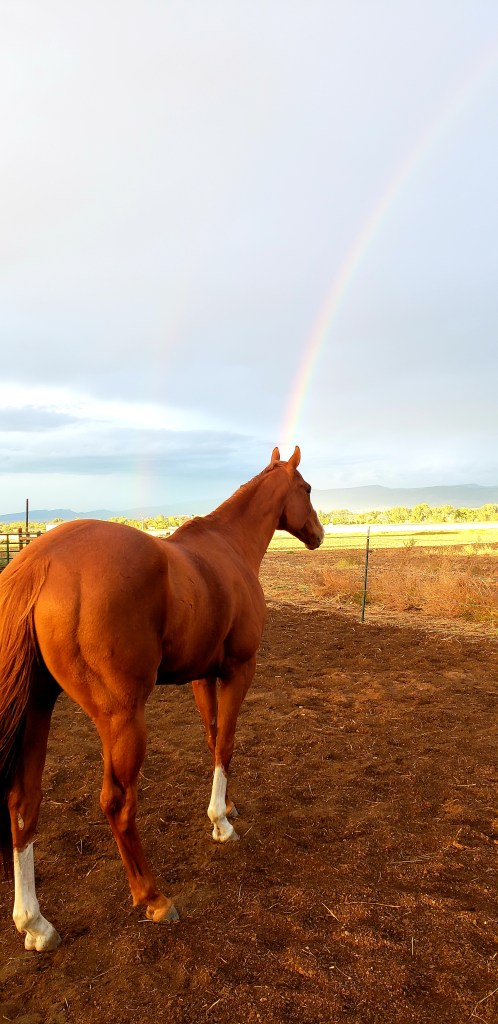
My sweet horse and ride Dulce

I’ve been going through a few things with Dulce that I’ve been trying to work out. I’m no horse whisperer, but my horses are human whisperers. Usually, they’re really good at getting through to me, but if I don’t hear them, it’s a full on scream. Dulce started screaming.

Despite several successful rides, Dulce started going downhill with no explanation. He got worse in the trailer stress wise. To say that he rocked the trailer would be an understatement, and it got to the point that Harley wasn’t too thrilled about getting in there with him. He suddenly got very gassy again, and often kicked at his tummy. He would poop at least 15 times, and I began to worry that I would cause him to colic. I needed to solve these puzzles, or I decided I would retire him. He comes first.

One thing is that when I start to get ready to go, Dulce gets Harley and Chaco running all over the place. If I catch Chaco, he tries to separate us. I decided he needed to be round penned before I load him in the trailer to blow off steam. My grandpa once told me when we were watching a racehorse act up before a race, that you need to let certain horses express their nervous energy before they’ll concentrate. Dulce is that horse.

I love doing round pen work, because it creates a dance between you and your horse. It opens up a whole new dialogue with your horse, and when they’re having issues, sometimes this is the best place to return to. He runs in circles with you standing in the middle. You direct his feet asking him to change directions and gaits. He may come at you, but you try your best to not move and again direct his feet away from you. You get him to change directions, so he knows that you are deciding where he goes like the alpha in a herd would. This creates respect, and then comes that moment. The circles that they trot around you get smaller, they’re keeping their eye and ear on you, they’re licking their lips, and then you turn your back to the horse and wait hoping that he will stop and walk towards you. When they do, it is exciting. It never gets boring. They then will walk with you in whatever pattern you walk. Dulce did this, and he loaded into the trailer more calmly afterwards. One problem fixed.

The gas, as you remember if you’ve read my blog, Dulce struggled with last summer. He had bad gas and would get colicy every single day until I put him on Ramard’s Total Gut Health, which he is still on today. I think he gets so excited and hot right before we leave that a lot of stomach acid starts circulating in his tummy causing excess gas. I’ve tried all sorts of pastes, and whenever I give him a paste, he gets extremely agitated. I decided to take a different route. An hour before we go, I mix up one scoop of the TGH in 4 oz of Aloe Vera Gel, not juice. with a tablespoon of honey. Honey is very soothing for upset stomachs. I mix it up thoroughly, pour it over a little bit of food with some alfalfa pellets that are softened with warm water. He loves it, laps it up, and no more kicking at his tummy. Second problem fixed.

Even though he loads calmly into the trailer, he doesn’t stand there calmly at all. He paws at the ground, rocks the trailer, and tries to get out by going through the window. I realized he thinks he’s in the starting gate at the track, and he’s itching to bust out. I closed the window, and oila, he totally calmed down and now stands perfectly calm. Harley no longer hesitates to load with him in there. Third problem fixed.

The pooping issue was easily solved. I give him Yea Sacc, which is a yeast culture, an hour before we go on a ride. It is designed to reduce digestive upsets or disturbances caused by stress. Since I started giving it to him before each ride, he now only poops twice. Huge change. Fourth problem fixed.

With these problems fixed let’s go ride. Next blog is about Dulce’s first trail ride! Woohoo!

Vallier’s/Mojo’s Spa Retreat

Before I go into his spa retreat, I wanted to lead with the good news first, which could end up burying the rest. But, oh well! Vallier (barn name Mojo) gained 17 pounds his first week here. I’m not sure if we will see much next week, because often their bodies will take a break before another weight gain. We’ll see what happens though. We’re heading in the right direction, and that’s all that matters.

Sweet Mojo

This blog will answer some of the questions I’ve received since we all brought Mojo home.

The first question is why does he have to be in quarantine? Good question. Well, we have no idea if he picked up a disease such as strangles or pigeon fever for example. We need to keep him in quarantine to see if anything emerges, and to protect my other three horses. However, I’ve decided to rename his time in quarantine as a spa retreat.

This poor guy needs the break that the quarantine time is providing. He needs to relax. He needs to sleep. He needs to be able to eat without being pushed off by other horses. He is getting fed in bed (four small meals a day), his nails (hooves) done, hair done (full body wash), bodywork (I do equine massage), select treatments (He has been wormed twice; once with a light wormer and this past Monday with Equimax. Next he will go through a round or two of sand clear), and dentistry work (Monday). When we go for walks, he can see my other horses, yet he never tries to walk towards them. He isn’t ready to be around others, so I see this time as meditation and retreat time. It’s allowing his body and mind to heal from what he went through.

He has nicer hooves than I could have hoped for.

After I wrote this, something interesting happened tonight. The UPS driver came, my dogs were barking at him, and suddenly Mojo started to run around. It’s the first time I saw him do something besides walk. The horse has some moves! He seemed perfectly sound. Later Dulce and Harley were playing, and Mojo watched. That is a first. He never showed an interest. Both are very good signs.

Second question is why aren’t I feeding him alfalfa and oats? Have you ever fasted before ? If you have, imagine fasting for ten days and then eating at McDonald’s afterwards and throw in some chocolate cake. You will be so sick! You will be running to the bathroom probably ever thirty seconds.

That’s the same for horses. Alfalfa and oats are really rich, and all they will do is make Mojo sicker than sick. They could make him colic at the worst, and get really bad, cow patty, watery, diarrhea, which will only cause him to lose more weight. I’ve successfully put weight on three other OTTB’s with the diet he is on, and if anything needs to change, I will. This is a work in progress, and he will tell me what he needs.

I pay attention to how he is after he eats, I watch for any changes in his poop, I make sure he is farting easily, I look to see if he is chewing at his sides a lot indicating bad gas, and I look to see how much he’s eating throughout the day. So far, we’re doing good. He gets beet pulp, which is low in sugar and starch and puts weight on horses; flax seed, which is filled with omega fatty acids and puts on weight, timothy hay pellets, and a bit of Nutrena Safe Choice feed. All low in sugar and starch, which is so important. He also gets California Trace Minerals, which he gobbles down, two tablespoons of salt, a splash of Forco (not even close to one 1 oz) Vitamin E, Flax oil, and an MOS prebiotic. I figure he ate poop to try and survive in the kill pen since they stop feeding them when they enter into the system. The MOS prebiotic binds on to salmonella and e coli bacteria escorting them out of the body. He also gets Aloe Vera Gel, not juice, to address any stomach ulcers he may have. Several studies in Australia were done that showed aloe vera gel can heal stomach ulcers. Eventually, I will add marshmallow root, but for right now this is it.

When a horse or person have starved, their organs shrink in size, so I don’t want to overload anything. This is why he gets small meals instead of two big ones. It is all in a mash to make it as easy for his system to digest. He also gets free choice hay. It will be awhile before we see changes on the outside of his body, because first the changes need to happen within. Once he heals inside, we’ll see great stuff happen outside, but that is a ways off.

The important thing is to go slow and steady. When you start to see improvement, you immediately want to feed more, and that is when you really need to stop yourself. Just give a bit more to see how the horse does….stay there for a few days. If everything goes well, add a little bit more. I started out feeding him once a day. When I saw he was stable there, I went up to twice a day and so on. I don’t plan on adding anymore food to his bucket for another week. I want to see how he does. If he does well at eating four small meals a day, I may not increase the feed for another two weeks, and then add a bit more beet pulp….see how that goes, and then maybe some more hay pellets….see how that goes. Slow and steady.

Why do I walk him if he is so thin? Doesn’t that hurt his weight gain? I did the same thing with Dulce. Horse’s are built to be mobile. It is important to keep their guts healthy and to prevent colic. They have this incredibly long digestive tract, so movement is really important to maintain motility. Also, his topline, and all of his muscles for that matter, have atrophied. I don’t want to put weight on him without muscles to support it. Otherwise, that topline, which is non existent, could stay that way. Walking him helps with his digestive system, and slowly but surely it helps build up muscle. It will help his topline redevelop. It also helps his hooves stay healthy and develop into the beautiful hooves I know he will grow. It also stimulates all of his organs that are starting to get stronger and hopefully more of a normal size. It also helps release tightness and stiffness. Each time we walk, he starts blowing out his nose, which is a sign that his back is releasing. He starts yawning and shaking his head, which is a sign of poll and TMJ release. It also helps us develop a relationship, and he gets to go out and see things. It’s great for his mind. We’re learning each other on each walk.

As you can see all the muscles that form the top line have atrophied. Slowly but surely, he and I will build them back up.

Do I hate horse racing because of what happened to Vallier? No. One of his trainers helped bail Vallier out. Others who knew Vallier came forward to tell me tidbits about him. Did you know that the one time he won a race, he had to dodge a loose horse that dumped his rider?

I don’t even know if it was someone from the track that dumped him in that field. I have no idea who did it. What I do know is that people that knew him in the past, cared about him and came forward to help him out. This is the horse racing I knew as a kid. Everyone on the backstretch helps each other out and the horses when needed. I know with the latest news that came out this week you probably don’t believe me. With regards to those people, they need to be banned for life and go to prison if all of this is true. All cheaters like them need to be banned from the sport, and there needs to be a unified, investigative body constantly watching and testing horses to protect them and the jockeys from selfish people such as this.

True horse people always put the horse first. I saw it all the time, and I saw it when all of these people that I’ve never met and good friends come forward and help out Vallier. It will always bring tears to my eyes, because my gratitude runs so deep.

I was asked by one person if I regretted getting a kill pen horse at. The answer is no. I will never regret bringing him here, nor will my husband. We are totally in love with him. He is a joy to spend time with. He loves to be loved, and he is happy each time I go out to him. He walks up to greet me, putting his head over the panels reaching his nose out to mine. He is a blessing in our lives, and each time I look into his eyes, I see more and more life in him. He is coming back. He has a ways to go, but he is coming back into the world with a good heart. I’m honored to be a small part of that.

Vallier Found Me

Rarely do I even bother to look at Twitter when I wake up, but for some reason this past Sunday morning I did. I was scrolling through posts retweeting a few when I came across this horse in desperate need of a rescue. He was in a kill pen. I wrote to Ann to ask where the kill pen was. and from there my day became about rescuing a horse named Vallier.

I often donate what I can to horses needing to be bailed out. I know the whole debate about not doing this, because it keeps the kill pens in business…how they hold the horse’s hostage, etc. How do you turn your back? What these horses go through in these pens and then when they go to the slaughterhouses is ungodly. They live in a hell that I can’t even imagine mentally and emotionally, let alone physically, surviving.

For some reason this horse named Vallier stopped me in tracks. My heart froze, and I looked at my husband saying, “We need to get him out of there.” I felt this horse’s panic, and I felt the same way about him as I did Dulce; I needed to get him here.

How did he get into the kill pen? I guess he was abandoned in a field by someone, picked up, and shipped to the kill pen. I’m not sure how long he was there, but I think it was for a decent amount of time.

After a whirlwind of events and five hours after posting a GoFundMe, I started working out the details with the kill pen. I sent them the money, arranged to have him shipped here (I don’t think I could have handled going to a kill pen and leaving with just one horse.) , and we finalized the details of the sale and paperwork. The following morning Brandon picked him up, and Vallier was on his way to Colorado. The next morning at 9:30am we loaded him into my trailer and we headed here.

My friend on Facebook and from back home, Mary Anewalt-Perrine asked me what Vallier is like. I decided to answer her in this blog. When we first met, he was very timid. He loaded up easily, and he immediately began eating the hay I put in his bucket. When I got him home, he was pretty scared….not spooky, but scared about what was about to happen to him. I took him to his corral, and he immediately grazed. I got him some hay, and he stopped grazing and dove into the hay. He really had no interest in me; just the hay, which was perfectly fine with me.

He likes to have his ears scratched, his jaw rubbed and his neck stroked. The first day he seemed very beaten down, tired, mentally and emotionally exhausted. I’d lie if I said I didn’t cry more than a few tears watching him. I will never understand how people can toss away a life like this. Personally, I think if an owner wants to send their horse off to slaughter, they should be the ones to haul that beautiful being to Mexico or Canada. They need to see what they are about to do.

By the evening, I saw a little bit of his personality. He likes to nicker at me as I walk towards him; especially when he knows I’m bringing fresh hay. He finally took a couple of Standley hay cookies from me, and he quickly realized they weren’t too bad. This is when he started to let his guard down for a bit, and he let me love on him. Before long though, he went back to being aloof. I respected that and gave him his space.

The next morning I noticed he liked watching these two calves play in the neighbor’s field to the west of us. He was paying more attention to his environment. Despite being totally exhausted and eating all night long, he continued to chew on his hay as his head bobbed trying to give in yet fight off sleep. He ate the entire night through, and I never saw him lie down. When I came back from the vet, he no longer could fight it off. He was down and out for about thirty minutes.

When he woke up, he was more sociable. He followed me around a bit in the pen. He rested his head on my shoulder for fifteen minutes. He rested his cheek on the back of my neck, and then he put his nose to my cheek breathing, resting, sighing…..

He should be aggressive. He should be mean and angry. He is none of these things. You can tell that he was loved throughout his life until he ended up in the wrong hands of someone. He is very gentle. He wants to have a relationship, which is such a lesson in itself about forgiveness. He shouldn’t want a relationship with any human being, but here is reaching out to me when he can.

He is sweet, and he loves it when I blow into his nostrils. He likes it when I play with his upper lip, and he likes to lick my hand. When my friend Jessica and her nephew came to visit him, he was timid. It will take some time for him to trust people walking up to him. He comes out of hiding and then brings the guard back to duty. However, I got to see more of him on his second day here.

This morning was a very different day. He was pacing and nickering for me wanting his bucket of feed. He ate it all down in fifteen minutes. He then nickered away at me for his fresh hay. When I was done with all of my chores, I went in with him, and the guard wasn’t on duty. He was lovey, wanted me to pet him, followed me around, and his ears were up in a different way. They stood up in curiosity, his eyes seemed clearer…..that fog from the past few days wasn’t so visible anymore, and he was awake. He finally is feeling safe enough to sleep.

He likes it when I brush him. He lets me run my hands all over him. I’ve never worried about standing behind him. I can tell that he was hit on the left side of his face. He flinches if I move my hand too fast, which he doesn’t do on the right side. He acts as if he thinks I may hit him. I spent a lot of time moving my hands all around his face and petting, scratching or massaging him letting him know that my touch isn’t going to be a hit or a slap.

His ears are always on me, and the sweetness that emerged yesterday stayed out today. He also began grazing as well as eating the hay, and he cleaned his bucket three times. When I walked out to him this evening, he once again nickered to me. I noticed how different he was standing. He was standing like a horse. He was standing as if he knew all of that other stuff was behind him. He was tall instead of sagging and beaten down. His spirit is rising and healing. We have a long ways to go, but this evening I saw his desire to get there.

Taking the Hoof by the Horn

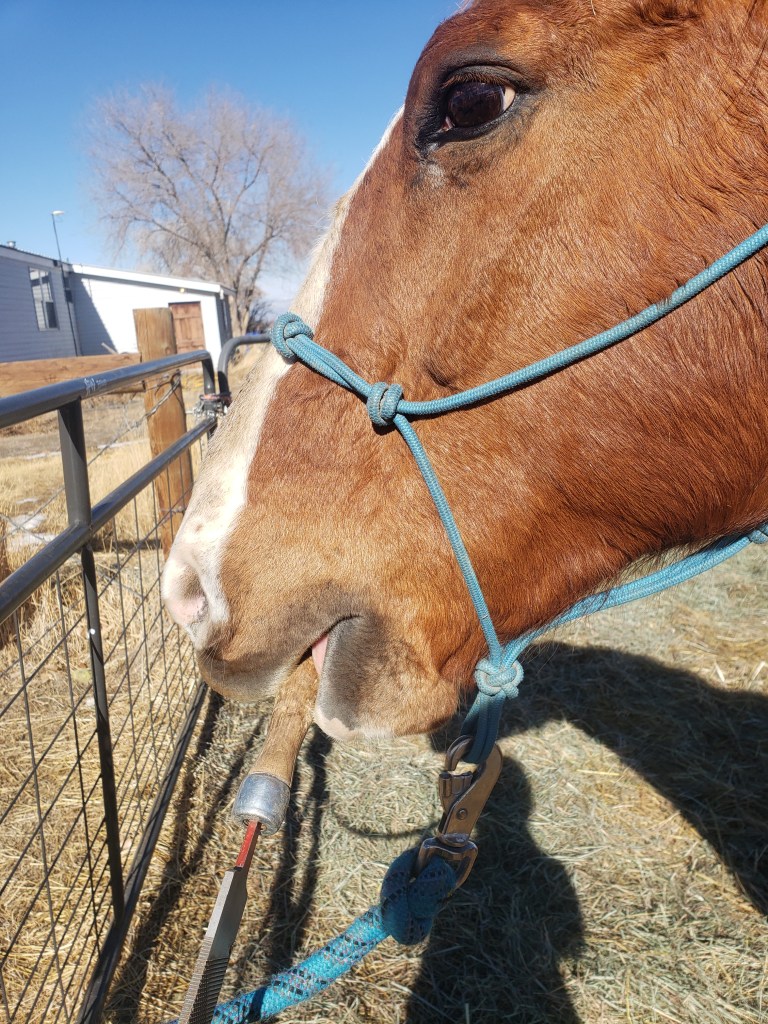
Harley chewing on my file handle

When I was given Harley, he was a God send for Shandoka who badly needed a friend. They became instant buddies, and he became my best friend within a short amount of time. His hooves needed a lot of help. His toes were way too long, and I believe his coffin bone had descended in his hoof capsule. He tripped constantly, and he didn’t like farriers at all.

One night a farrier came to work on him and Shandoka, and I’m pretty sure Harley wanted to trample him to death. He was furious with him before he even touched him, and the white’s of his eyes were blinding. His ears were so pinned to his head that I thought they would never stand up again. His previous caretaker would put on a pair of shoes in April, and Harley would still be wearing that same pair of shoes in October when they were pulled off. This has caused a lot of long term issues with his hooves, and I can’t even begin to tell you how overwhelmed I felt. I knew that he needed to be barefoot trimmed, but there is nobody around here that did true barefoot trimming in the style of Pete Ramey or others.

Harley is a sweet, gentle horse, so seeing this side of him shocked the heck out of me. He was telling me something, and I listened.

He told me that I needed to take a crash course in barefoot trimming. I found Pete Ramey’s list on Facebook that is sadly no more, bought his book and several videos in a night of pure panic realizing it was going to fall upon me, and I got help from Pete directly through his list as well as Heather Dwire who guided me how to trim Harley. Luckily, Derek Green came over for his set up trim, because so much had to come off the first time. I don’t know if I would have had the nerve to take all of that off the first time around. I hadn’t been up to that point.

After Derek left, it was all up to me, and this is what I’ve learned and continue to learn from Harley who is the best teacher.

  1. Harley was such an angry, pain in the butt when I first started trimming him. He would plant his feet, and fight me every step of the way when I tried to lift his feet the moment he saw my farrier tools. If I went out just to pick his hooves, no problem. The moment I pulled out my nippers or my file, holy cow the fight was on. Most times I had to pull one of his legs forward at the knee or mid cannon bone to get his hoof off the ground. It was so exhausting. His hind legs, the moment I got a hoof off the ground, he would start trying to kick it free of me. When he realized that I wasn’t letting go, he would lean backwards trying to throw me off balance. He pooped on me twice; that was fun. I think my arms were always two inches longer at the end of our sessions, and I definitely stunk afterwards. I stuck with it, but I quickly realized the way I was doing things wasn’t working. It wasn’t getting through to him that he no longer had to worry about shoes going on his hooves. So, I started doing only two hooves a session, and I would go back and forth between the two, so I never stayed on one hoof for too long. His patience increased. He started lifting his hooves when I asked. I started to not trim his toes with my nippers; I just stuck with the file, and he totally mellowed out. After doing this for awhile, we can do all four hooves in one day and in a short time. He stands perfectly for me. He lifts his hooves when I ask, and when he asks, he gets a lot of loving breaks. Harley taught me to be flexible.
  2. Let the horse have some revenge on your tools. I let Harley take out his frustration by biting on the handle of my file. He holds it in his mouth while I hold on to it, so it doesn’t stress out his teeth. It’s a pacifier basically.
  3. Listen, listen, and listen to the horse
  4. When you need to have guts, take a deep breath, and then go for it. There were so many times I didn’t think I could do what he needed me to do, but he let me even during our arguments. Of course Heather was nudging me in the background. I was so worried about making him sore, but even during our arguments their were moments of trust that gave me the go ahead and bring the toe back a bit further. He allowed me to do what I never thought I could do.
  5. Give hugs as needed
  6. Let the hoof speak to you. Everything you need to know is there in that hoof. If you don’t understand the language, go and ask for help. Hooves have their own language, and it takes awhile to learn it. I am far from fluent….I speak broken hoof language at this time, but I’m learning more and more words each day. Harley’s hooves scream at me sometimes, and sometimes like yesterday, they serenade me. Harley’s hooves are teaching me another language, and he taught me to ask for help.
  7. Be patient with yourself. When I lose patience with myself, Harley loses patience with me and it falls apart. This is when I walk away for a bit. I usually lose patience, when I can’t understand what his hoof is trying to tell me.
  8. Don’t lose patience with the horse when they’re having a melt down. You’re just shooting yourself in the foot. This is when the horse needs you to remain calm and let them know they are safe with you. Harley said that to me over and over, and I adjusted over and over for him. Listen, listen, and listen.
  9. Really pay attention to what the horse needs. Pete Ramey always asks, “How does the horse move? Is he comfortable?” Harley’s heels probably should come down a little bit more even though they are within the normal ranges of sole depth at the heel…but just a bit more on the high side. You don’t want horses to be stood up at the heel. Think about what it’s like walking around in high heels all day, 24 hours a day. Well, that’s what it’s like for horses that have high heels, and it causes so much dysfunction in the hoof. I tried taking his heels down a bit more, and he didn’t move nearly as well as when I kept them where he naturally wore them down to. Harley taught me to pay attention, and answer those questions that Pete asks each time I trim.
  10. Pete taught me a lot about the hairline at the coronary band of the hooves. It is always dynamic, always moving, and it is not an accurate tool to base the trimming of hooves upon. I’m always looking at Harley’s hairline, because if it goes up at any spot, I know I have a flare to work out. As soon as I do get it worked out, Harley’s hairline mellows out. That hairline is part of the hoof’s language. Pay attention to when it speaks to you. Harley has taught me that not all receding hairlines are about baldness.
  11. Harley will always have problems with his hooves. He probably has remodeling of his coffin bones…maybe a ski tip, and a negative palmar angle of the left hoof. The NPA has improved but not disappeared. I should get x-rays, but whenever I do, it is such BAD news. His hooves show me what is going on, and I don’t want the x-rays to confirm it just yet. I keep following Pete’s guidelines, and it’s amazing how well he is doing….how well he moves….how fast he can run with the thoroughbreds at twenty years old. His quarters always want to flare out….his toes still want to run away if I don’t trim him every two weeks in the summer, and these issues will probably never change, but I keep trimming him with the intention of creating that change. Harley supports this, and today none of the quarters in any of his hooves were flared out! Okay, probably because it’s winter and their hooves barely grow during the winter. However, this is the first time. Harley has taught me to not give up.
  12. Because of everything I do for Harley, rehabbing my thoroughbreds’ hooves has been a lot easier. He prepared me for them. He taught me for them and others, and he gave me the confidence to trim other horses besides mine.

He is a kick in the pants, always trying to pickpocket my phone, and loves to grab hold of my hood when I’m not looking. Harley took care of so many kids on trail rides, he took care of Chaco and I after losing Shandoka, and he is one of the best hoof teachers out there. I don’t know what I’d do without him.

If you want to learn more about barefoot trimming and Pete Ramey, please visit his website at http://www.hoofrehab.com. He has a page dedicated to several articles that he has written about diet, laminitis, hoof capsule rotation, etc. He also sells videos and the most detailed book out there on barefoot trimming. I highly recommend all of it.

Ulcers or Maybe Not Part 2

On our first walk down to the hay field

A few people asked me how Dulce is doing. Before I start, let me tell you that I’m sick. I have a nasty cold, and my brain is backfiring quite a bit. With that said, let’s get to it.

Dulce is doing great for the most part. He now has pellets galore, he hasn’t had anymore episodes of gas colic (knocking on all the wood and anything else I can find), diarrhea no more, and the weight fluctuations have stopped. I did take him off of Butyrate for a week, and there was a decline. I put him back on it, and all was well.

Every now and then there are some mild ups and downs, but they don’t equate to any weight loss. However, during training, he gets so worked up that I can feel all of the gastric acid shooting into his stomach. It makes me cringe, and a large part of this I fear is my fault.

When I went to pick him up in Kentucky, I was offered to bring home a mare with me as well that was his pasture buddy. We weren’t set up at the time to take in another horse, so I had to bring him alone. I think this hurt him mentally and emotionally. I wish I would have brought her home anyway. So, now I need to undo what I did.

Whenever I load him into the trailer to leave the house, he has a meltdown in the trailer. I have to immediately jump into the truck and drive off, and once we do, he immediately calms down. The thing is these meltdowns may not only cause him to hurt himself badly, his stomach goes to heck and back.

This of course concerns me, because I don’t want him to develop ulcers. Also, I worry about his gut health going downhill on me again. I started pondering what to do and how to undo his fears of being permanently separated from Chaco and Harley, which will not happen.

I had dreams of Dulce before I got him. Shandoka was running straight for me, he runs right through me, and behind him I see Dulce. Dulce comes right to me and drops his head to me. Maybe Shandoka was the answer here. When I agreed to take Shandoka, he was separated from his sister. He called and called for her. I knew that I needed to get him to trust me, depend upon me like he did his sister. As soon as I got him halter trained, I took him for walks in the field that surrounded his paddock area.

Shandoka and I walked who knows how many miles together over the course of his life. We didn’t have a pasture at the time, so I’d walk him around and let him graze along the side of the road. He learned to trust me no matter what drove by….a semi, motorcycle, or a car with a nice glasspack exhaust system. I decided that maybe this is the answer for Dulce. Maybe it would help calm him down like it helped Shandoka.

After I work with Dulce, we go for a walk down to my hay field. The first time we went down there, I was sure I made a mistake. All we did was circle and do figure 8’s, because he was so hot and his mind was everywhere and anywhere but with me. I kept focusing on my breath to keep my energy down hoping he and I could find balance. Finally, after twenty minutes, he took one bite of grass. I took that as a win, and we headed back to the other horses. Since then he has improved each day, getting calmer and calmer. I haven’t even tried out the trailer yet, but soon I will begin to incorporate that into our walks. I will load him before and then after the walk before I reunite him with Chaco and Harley. My hope is that this will teach him that no matter where we go, he will come back home.

For his gut, to help him through this training period, I’m flooding it with good stuff. He is still on the butyrate, the MOS prebiotics, and Ultra Gut Health. Now I have him back on gastromend as a preventative for ulcers, and FORCO, which is really good for nervous stomachs. It also will flood his gut from beginning to end with wonderful bacteria. I also give him Aloe Vera Gel. Studies in Australia have shown that aloe vera gel is much better than juice for the prevention and healing of stomach ulcers. The second best choice is Aloe Vera powder. I will write more about the use of herbs in another blog.

Hopefully, the bases are covered, and we’ll see progress. I absolutely love working with him. He has such heart, courage, and intelligence. Hopefully no ulcers will develop, and his gut health will continue to improve. Even though things are well, I believe it will be another six months before he finds his balance. So far so good, because I can still rub his tummy and he eats like a horse as the saying goes.

Rip Off The Band-aids!

Oh, how I love Chaco. He has so much heart

I haven’t posted an update about Chaco for awhile, because I mainly have nothing good to say. I try to keep a positive outlook for everyone, but inside my heart breaks for him every single day. I don’t think a day goes by that I don’t shed tears over his right hindleg. I see the pain it causes him each day, and I feel like I’m failing him each day. Why? I can’t make it stop. We have tried and are trying everything we can to keep him as sound as possible. The fact of the matter is that his suspensory will probably give out in his left hindleg one day, and that day will be his last. Feverishly, I’m trying to do everything I can to prevent this. I look at Chaco as the walking wounded after useless band-aids were used to keep him racing.

If you’ve read this blog from the beginning, you know that Chaco went down in a race after clipping heels with another horse. Two other horse went over Chaco; you can see two hoof prints in white hairs on his pelvis. It is believed that he fractured a rib and his pelvis. The pelvis fracture is usually an instant death sentence, but somehow he healed thanks to the care that he received. However, three major chips broke off from his stifle in the wreck, and instead of having them removed, I believe he was blistered. His trainer states that he didn’t know that Chaco had them, and maybe he didn’t, but I doubt the vet missed that. The trainer also stated that I should blister Chaco instead of having the chips removed, because that is what he does for all of his horses that have chips.

Blistering is a band-aid. Not one surgeon or vet that I spoke to thought blistering was the answer for chips; they all said arthroscopic surgery was the best and only choice. It doesn’t heal anything, doesn’t ameliorate a thing, and to be honest all it does is create more damage. The longer the chips are in there, the more damage there is to the cartilage. Blistering or pin firing just makes it so the horse can’t feel the damage that the chips are creating.

Why do I bring this up again? Because three more horses died at Santa Anita in three days. They aren’t only dying at Santa Anita, but at other tracks as well and in other sports besides horse racing. Why are they dying is the question often put to me by so many as if I would know. I never know what to say.

Maybe I have known all along as I watch Chaco rest his right hindleg… again….leaning his weight to his left hindleg… again.

My guess is that there isn’t any one reason except for the use of band-aids regarding all of these deaths. There is so much pressure to make money, to pay the bills, to have winners that become sires, and to keep horses running that the use of band-aids for injuries is widespread. Injections, shockwave therapy, overuse of anti-inflammatories, pin firing, blistering and on and on and on are all band aids to cover up pre-existing conditions.

My guess is that every single horse that died at Santa Anita had a pre-existing condition like Mongolian Groom did that required rest to heal. My guess is that there were minor lesions or stress fractures beginning to form, but due to the pressure put upon trainers by people that want to see horses run, instead of sending them to the farm to rest and heal up, band-aids of all sorts are thrown at these horses to make them sound enough to race. Not only does this put a horse’s life at risk but the jockey’s as well. I don’t know how a jockey hasn’t been seriously hurt or worse since all of this began. Whenever a trainer puts a horse out there with a pre-existing condition, not only is that horse in danger, but all the horses in the race are at risk of getting hurt….and all of the jockey’s lives are in jeopardy. But band-aids are cheaper I guess…..

No amount of shockwave therapy or drugs will heal stress fractures. Time and rest is what heals them. We need to change our way of thinking regarding horse racing; look to other countries and adopt what is working such as cross training and more time out of the stalls. Jockeys and trainers have suggested over the years that horse racing shut down for a month or two during the winter months. This would be a perfect for horses to have time off to rest and heal up….to get out of the stall and be a horse and run around in the pasture, which would actually strengthen their bones.

In Australia, they give their horses breaks from the track. Winx got two breaks a year. While racing, she developed a chip, and instead of blistering her, they had it removed and did the proper rehab. She came back to racing after she was cleared, and look at what she accomplished. Winx is a shining example of how right everything was done in my opinion, and this is what we need to bring to horse racing here in the United States.

If you want to be part of the solution, please call your Representatives and Senators asking them to vote “yes” on this bill. It will not solve all of the problems, but it is a great start to creating positive change in the horse racing industry. This will create a centralized agency that will oversee all of horse racing and create unified rules across the country. Right now each state regulates itself, so there are all of these different jurisdictions from track to track. You can read the bill here https://www.congress.gov/bill/116th-congress/house-bill/1754/text. Here is a list of the current Senators and Representatives https://www.govtrack.us/congress/members/current. This is where change can start, but Congress needs to hear your voices loud and clear.

I would love it if all racehorses diagnosed with chips were banned from racing until they were removed arthroscopically. Also, how did the chips develop? Were they from a trauma like Chaco, or were they from stress to the bone. If it is the latter, those horses should be red flagged and watched closely throughout their career. I feel bad for the vets that examined Mongolian Groom and other horses that have died. If their owners/trainers are using banned methods to mask lameness such as shockwave therapy or osphos, it makes it very hard for them to diagnose problems. All of these masking agents and bute and osphos….they need to go. Everyone complains about lasix, and I don’t like lasix, but the true problem lies in bute and all of the other drugs that mask lameness. Lasix does not do that. These other drugs and methods will destroy American Horse Racing in my opinion.

If we can get this law passed, it’s time to rip away these band-aids that lead to so much tragedy and suffering. Santa Anita has implemented many great changes, but as with the recent deaths and the death of Mongolian Groom, the changes aren’t catching all of the horses at risk. Dr. Bramlage in his report on the death of MG during the Breeder’s Cup Classic stated that the vets on scene needed to get an xray at just the right angle to see the lesions that led to his death. Basically, anyone could have missed it. We need a think tank to come together of people from all parts of the industry, especially the grooms, and people from the outside of the industry to come up with better ideas. The safety of the horse and jockey always need to come first.

If Chaco’s chips had been removed, a $2,500 surgery, he may not have been able to race again, or he may have, but he could have had a second career. He would have been sound. I wouldn’t be crying on his shoulder literally every single day. All I know is I’m so grateful that I got him, that we were able to get the chips out, and how blessed I am to be able to take care of him. He is the most amazing horse. He lets me do whatever needs to be done for him without a complaint ever. He misses going out for rides, I can tell by how he looks at me when I go to catch Dulce or Harley to go work, yet his attitude still remains positive and loving and playful. It’s time for me to go out and give him a shot of Adequan that isn’t working as well as I hoped it would, and he will stand there patiently, calmly, and nuzzle me after I pull the needle out of his neck to let me know it’s okay.

Smooth Ride

Dulce is coming along nicely. I had the chance to take him to the indoor arena a few times, and he did surprisingly well. He is really soft and responsive with his S Hack and Side Pull. He also showed me one day that he does care about taking care of me.

The first time I took him to the indoor, I didn’t even expect to ride him. My plan was to walk him around, do some groundwork, and then come home. That’s kind of what we did. He did so well, and got so calm I decided to get on him. I thought we’d just walk around the arena in as many different ways as we could and go home. Then he wanted to trot, and I decided why not? After trotting for a bit, I could feel that he wanted to go to the canter, but he was waiting for me to give him the go ahead. I thought that the ground seemed soft enough if I came off, so why not? Oh my gosh, he was perfect! He was amazing, and he was so smooth. He never tried to take off with me, and his gait was beautiful. He covered a lot of ground with ease, and not once did I feel uncomfortable or feel worried. We flowed together, and there was not one person around to see it. I thought about pulling out my camera to video it, but I decided against it since it was our first time at the canter.

The next time we went it was a different story. He and I had different agendas. I wanted to canter him in front of someone, and he wanted to play. My friend Jessica and I went together, and he was totally in love with her mare Riser. Never mind how much he wanted to play with Cisco. I was frustrated at first, but then I realized how important this ride was. He learned that being around other horses doesn’t mean it is time to race, and he learned that I was still there much to his chagrin.

The third ride was great yet again. I was by myself, and I took this video the second time I cantered him. The thing I love is there was a man replacing sodas in a machine, and the man slammed the door to the machine shut spooking him. It was a loud metal sound that echoed down the hallway next to the arena. Being on a horse while they are cantering or at a gallop when they spook is challenging to stay on. Instead of overreacting to the man, he took care of me and gently moved to the side as he cantered. They also had a roping event the day before, and he could smell the steers in the cattle chute. He wasn’t too sure of that smell. Again, instead of tossing me or bolting, he took care of me, which gives me a lot of hope for our relationship and future.

The second video shows how amazing he is to ride in my opinion. One thing is for sure, I love him and I love working with him. Let me point out that all of this was bitless. Just because he was a racehorse it doesn’t mean he needs a bit to control him or ride him. I had him on a loose rein, which doesn’t mean it was hanging down to his knees. It means that I wasn’t holding the reins tightly, that I wasn’t all over his face, but I could quickly gather up the slack if I needed to for whatever reason. Thoroughbreds do not need a hard on the mouth bit to be ridden. Since I’ve had Dulce and Chaco, I’ve never ridden them with a bit. It is a great feeling.

Harley, Harley, Harley

Harley loves swirling his food around in his bucket, and he often has a dirty nose afterwards. I have no idea why Bill never smiles for a selfie.

Harley is twenty years old going on ten. He bosses the other two horses around, loves to run around bucking like a mad man while chasing the other two around, loves rolling back and forth through the mude or snow, but the moment a white, plastic bag blows into the paddock, he hides behind Chaco who is the brave one.

When it is time to worm the horses, the wormer is a white plastic bag to Harley. Chaco and Dulce are easy peasy to worm. Harley becomes the most obstinate sun of a gun the moment he sees that little, white tube. The moment the smell of it, no matter how I try to disguise it, hits his nostrils, he tries to run, back up, run over me, or push me away from him. He has the nose of a hound dog. When Shandoka was alive, he took it within five minutes after watching Shandoka do it. Dulce and Chaco have no sway over him.

I have tried everything. I fill up tubes with honey and practice with him for two weeks before, and he will happily take the honey. The moment I come out with the actual wormer smothered with honey, he knows. I don’t know how he knows, but he knows immediately.

The last time was such a struggle that I think he either gave me a hairline fracture to my index finger or slightly dislocated it. All I know is it hurt like the son of a gun that can be during worming. Besides that, I went through two tubes before I finally got the third in him. This is not working. I even tried the type that you put in their feed. Harley who never passes up a bucket of feed, snubbed his nose at it.

When it was time for worming this Fall, I decided to play to his sweet tooth. I don’t feed my horses sugar, because it weakens their hooves and is not good for them on so many levels. However, once every three months, I decided to make an exception. I got apple flavored wormer, applesauce, peppermint leaves, Ambrosia honey, and I headed home.

I made him a nice bucket of feed and made him a worming cookie. I put down a layer of alfalfa flake, peppermint leaves, a thick layer of honey, unsweetened applesauce (I had to go for something with less sugar to make me feel better), the wormer, applesauce, another thick layer of honey, peppermint leaves, and lastly more alfalfa flake. I then handed him his bucket, and lo and behold he inhaled that wormer. He cleaned that bucket until it was spotless! All of his favorite sweets in one bucket at the same time made for a very happy horse.

I kept looking all around to make sure he didn’t throw any of it out. He didn’t! Happy dance for me. Yes, a small ring may appear in in his hooves, which I’m not going to be thrilled about, but I got him wormed without any trauma to him or me. Finally, a win!!!!!!

OTTB Troubles With Trimming

When I was a kid, one of my favorite things in the world was go watch our horses work on the track in the mornings. We’d leave before the sun rose, and head to the barns. The smell of warm oats and hay, horses dancing around, Spanglish words floating along the airwaves was heaven to me.

I never sat in the seats at the track. I stood on the rail waiting for my horses to come around back home. Often there would be a thick blanket of ocean fog sleeping on the track. Sometimes I could only hear the sound of their hooves running by, but usually they would emerge at the last minute for me to see them gliding over the ground with grace and speed.

Back at the barn some horse usually threw a shoe. The farrier would come in and go to work. I stood outside watching wondering how in the world they did what they did. A lot of people don’t know that racehorses are usually tranquilized before trimming AND they are trimmed from the left hand side. This means that they trim and shoe the right sided hooves from the left side of the horse. Don’t believe me? Then watch the video:

Here is a screenshot of it

Why do they do it this way? Well, they trim them in their stalls, so there isn’t much room to work. Also, if the horse is tranquilized, then the horse is difficult to maneuver if needed.

When racehorses are retired from the track, I start them off as if they were two-year-olds or younger. There are a lot of things that were never asked of them like other horses. Getting their hooves trimmed is one of those areas. They never had anyone trim them on both sides with a clear head.

A lot of people think OTTB’s are misbehaving when they act up at a trimming. They really aren’t. They’re telling you how nervous they are. If they’ve been tranquilized each time they were trimmed and shod, guess what? They never learned to stand for a farrier properly.

When I start working with an OTTB, I spend a lot of time walking around all sides of them petting them all over and running my hands down their legs on both sides. This will tell me if they are used to being handled on the right often. If the horse has, the horse is calm; if not, they aren’t. If the horse isn’t calm, I spend a lot of time running my hands down their legs until the horse feels comfortable with that.

When I first lifted Chaco’s right hoof just a few inches off the ground, he dropped to his knees. I think it shocked and freaked him out that I went to that side, and wondered why I was doing it all wrong. It scared me to death. It was the one and only time he did that. When I work with a new OTTB, I start picking up their hooves on the right, I lift them only an inch or so off the ground at first. When they’re comfortable there, I go for a bit more as long as they remain comfortable until I get to where I can comfortably work on a hoof.

When I began trimming Chaco, I discovered he was a salsa dancer. As I held either of his front hooves, his hind end danced all over the place while I worked. It made us both a nervous wreck. I thought time would resolve this; it didn’t. One time he almost fell again, and I was fed up with doing everything the “normal” way. Sometimes, you need to let go of the way things should be done and create something that works instead. Who says a horse has to be trimmed one hoof at a time anyway?

Rather than working on one hoof until completed, I worked on him clockwise. I would start on the left front picking the hooves, then go the hind, over to the right hind followed by the right fore. I then nip the lateral quarter on the left fore and work my way around. I got this idea from a local farrier I watched a couple of years ago work on a green horse. He was nervous, so instead of focusing on the one hoof, he kept going back and forth between the left front and right front.

Working this way kept Chaco calmer. Instead of dancing and getting anxious, he became curious as to what I was doing. Now he stands calmly for me while I trim. He tends to want to pull away more on the right side than the left, but that has even improved. Considering his operated leg, I still use this method with him as it relieves the stress on that leg as I trim.

If your OTTB is a struggle being trimmed or shod, get creative. Keep in mind that your horse might need to relearn how to do all of this. Ask your farrier to try working clockwise. If you have more than one horse to be trimmed or shod, ask your farrier to work on the front hooves first going back and forth between the two as he or she works on them. Your farrier can then go on and work on the other horses, and then come back to working on the hind hooves after done with the other horses giving your OTTB a mental break.

I find that instead of forcing my horses to do it a certain way and supporting what they can do, the quicker they come around to accepting being trimmed as a good thing instead of like a dental exam. Chaco told me he was scared, so I changed my ways. Now he falls asleep as I work on him. Listen to your OTTB, and you tw0 will go the distance.

Holy Cat!

Goldie the Stow Away

Time for our second adventure. Not sure he looks at it like that, but I’m sure one day he will…..I hope. Trailer is hooked up…check. Key in the ignition for a quick get a way….check! Pull the cat blankets and food out of the trailer…check! Look in the tack for cats….check! Go get horse and load him up…..check!

Dulce loads up easily, and is calm in the trailer thank goodness. I close the window and off we go. I pull in, get out, and I immediately notice that the trailer isn’t rocking back and forth like last time. Dulce is patiently waiting inside the trailer. I hear a moan. It’s a an odd sound, one that I never heard a horse make before, and then the sound comes from the trailer again much louder. Oh my gosh, a cat is in the trailer! I open the side door, and there she is holding on for dear life in the hay feeder. Even though my hay field is kitty corner, an accidental pun intended, from my neighbor’s place, I doubt she’ll find her way home. I quickly close the door, apologize to Dulce, and turn around and head back home. When we get back, she is curled up in the feeder much calmer now. I lift her out, and she takes off. Only me stuff like this happens to. I wonder how long it will be before Goldie forgives me.

Note to self: Always check the hay feeders before I drive off.

When I decide to desensitize my horses to sounds in the horse trailer, I go all out. Surprisingly, he takes it all in stride. When we get back to the arena, he stands calmly waiting for me to open the slant. I can’t believe the night and day difference from our last trip. He learned.

We walk into the arena, and he begins lunging himself. This time he is much calmer about everything. He must have learned the more riled up he gets the longer he works.

Before I know it, I decide to put the saddle on. He stands perfectly. I ask him if it’s okay for me to ride him. He drops his head to my heart. I climb on, and he stands perfectly. His attention isn’t on me enough though, so we yield hindquarters and walk off a few steps and repeat. He does really well considering he’s nervous. Only wanted to toss me once to go for a run. I stay on him until I feel like he and I are working more like a team before I hop off. I would have loved to trot him, lope him, but we need a bit more work together before I add speed. Everything I’m asking of him is so different for him. Even though I want to do more, I need to take it slow. Take a few steps and give him some time off to think about it. I’d rather take it slow and get it right instead of rush it and have huge gaps all over the place in our relationship.

That’s what this is all about; us learning each other and how to work together. I don’t believe in forcing a horse to be submissive. Instead, I need to learn from him even more than he needs to learn from me. He is so smart. Give him a day off to think about it, and the following day he is ready to take the next step.

I can’t wait to see what he’s like the next time around minus a howling Goldie I hope.

P.S. Goldie did show up tonight after her escapade as a stow away. However, she is avoiding the horse trailer as if it is laced with the plague, but she is following Dulce everywhere now. I think he has a new friend.